2026 Travel Megatrends: What’s Actually Going to Matter
For DMO leaders who want to survive the AI wave, and their board.
Emily Zertuche / January 8, 2026 / 12 min read
Back from the holiday break, coffee in hand, inbox already full. Happy National Circle Back Week to those who celebrate.
If you’ve already sat through a “quick sync” that somehow lasted an hour, you’re not alone. 2026 has a way of arriving fast, and it’s already clear that travel, tech and destination marketing are moving quicker than most of our planning cycles would prefer.
You can feel it in the work. In the dashboards that don’t quite tell the full story yet. In the budget convos that suddenly sound different than they did in Q3. In the quiet realization that some strategies look great in a slideshow, but behave very differently once they’re released into the wild.
The most important signals right now aren’t dramatic or headline-worthy. They’re incredibly sneaky-sneaky, sir. They’re showing up in how visitors are discovering places, how decisions are being shaped by AI (often without anyone calling us out), and how expectations are changing faster than we can analyze or document.
What follows are the trends and pressures I believe will matter most this year. Most is grounded in what’s already happening and what many of us are navigating in real time. Some of this will feel obvious. But, if it makes you stop mid-scroll and think, Well.. shit. We’re dealing with that, too then I’ve done my due diligence.
And truthfully, this post is not chasing short-term hype, but noticing what’s already working, what’s quietly breaking, and where we can just stop burning our energy on things that look productive but aren’t.
The goal (and a quote I live by):
Make it simple, but significant. - Don Draper
Leisure is Still the Main Character (and Group Travel is Borrowing Her Wardrobe.)
Leisure travel is still king in 2026… but it’s not “revenge travel” anymore.
It’s more intentional, more identity-driven, and frankly, just much more selective. The cleanest snapshot I’ve seen comes from Global Hotel Alliance (GHA) research (they’re working with a large base too, 32M+ travelers in their ecosystem), and the findings are pretty consistent: travelers are choosing trips that feel like them, not trips that look good in your generic sizzle reel.
What’s changing (and what isn’t)
Leisure isn’t slowing down, but it’s growing up.
Revenge travel was the “fuck-it book-it” era at its peak. For 2026, it’s telling us a different story. Travel is:
“Book it… because it’s worth taking the PTO, coordinating my kid’s childcare, and choosing something that actually matches how I want to feel once I’m back online/or in-office.”
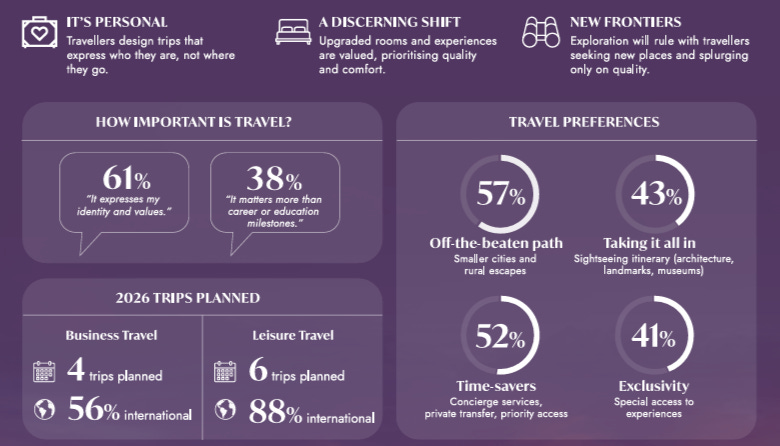
GHA’s 2026 findings are telling us:
Travelers plan 6 personal trips vs. 4 business trips in 2026.
47% expect leisure travel to increase; only 12% expect to travel more for work.
A big share of travelers describe travel as tied to identity and values and not just taking PTO.
Translation: people aren’t collecting destinations like Pokémon anymore. They’re curating. And curated visitors don’t respond to those “Top 10 Things To Do” lists we're all are conditioned to publish on our DMO site the way they used to. They want the version of your destination that matches their priorities: rest, connection, comfort, ease, niche interests, and values.
And Gen Z? They’re not even subtle about it. They’ll prioritize travel over traditional milestones, any day. (Sorry to all the bosses that set those goal-setting meetings last month, but the kids would rather climb Machu Picchu than climb the corporate ladder. And honestly, I get it.)
Business + Group Travel: Not “Back” the Way We Remember. More like Revamped 2.0
Group travel isn’t dead. It’s just showing up like all of us in January: a little tired, more budget‑conscious, and asking “what’s the actual point of this?” before agreeing to anything.
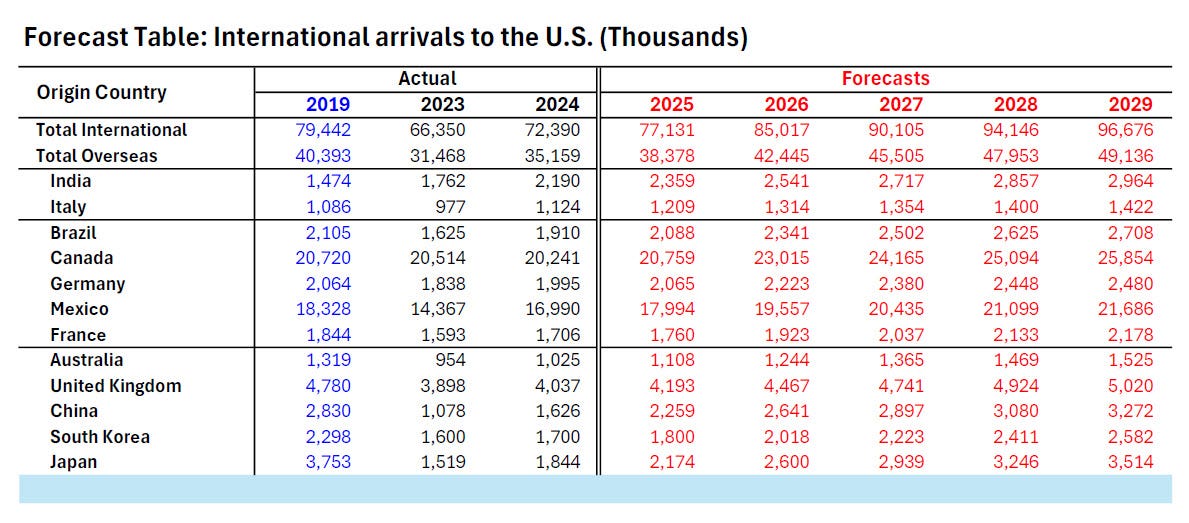
On the macro side, U.S. Travel forecasts show inbound international visits are expected to return to growth in 2026. The 2026 FIFA World Cup is one of the big accelerants for inbound demand and broader travel volume in 2026 bringing an estimated 5-6 million fans to North America. And it’s not only heads in beds. FIFA travel skews toward big spenders, longer overall stays, and trip stacking with visitors anchoring a trip around matches and then building an itinerary around it.
What matters right now is how that demand shows up. Based on a call I had with Sojern (now acquired by RateGain) in late-November, insights (blending traveler intent, hotel data, and air movement) indicates World Cup demand doesn’t ramp gradually. It spikes around three very specific moments: the draw that happened on December 5th, the ticket notification alerts, and first‑come ticket releases. We’re still pre‑spike, which is exactly why January matters before heading into the fiasco of June 11th - July 19th.
And travel demand hardly ever comes with literal calendar invites. And yet, this one does.
If your destination is within reach of a host city (and especially any destination 30-40 miles from the host city), you should already be having those internal conversations… the ones that start with “we should capitalize on this” and end with a shared doc, a few good ideas, and absolutely no clear owner. (Assign an owner.)

FIFA + America 250: The Patriotic Surge Nobody’s Really Ready For
2026 isn’t just about soccer, either. It’s America’s 250th birthday, which means Messi jerseys and MAGA hats are part of the same demand curve.
Early data shows that historically significant markets are already pacing ahead of 2025. South Dakota jumps from 6% to 13% occupancy for July 4th week, Washington D.C. ticks from 8% to 9%, Virginia from 3% to 5%, while North Carolina dips from 16% to 12% (still ahead of most states). Booking windows average 331 days nationally and 333 days in D.C., meaning the folks who’ve already blocked out their calendars are way ahead of you.
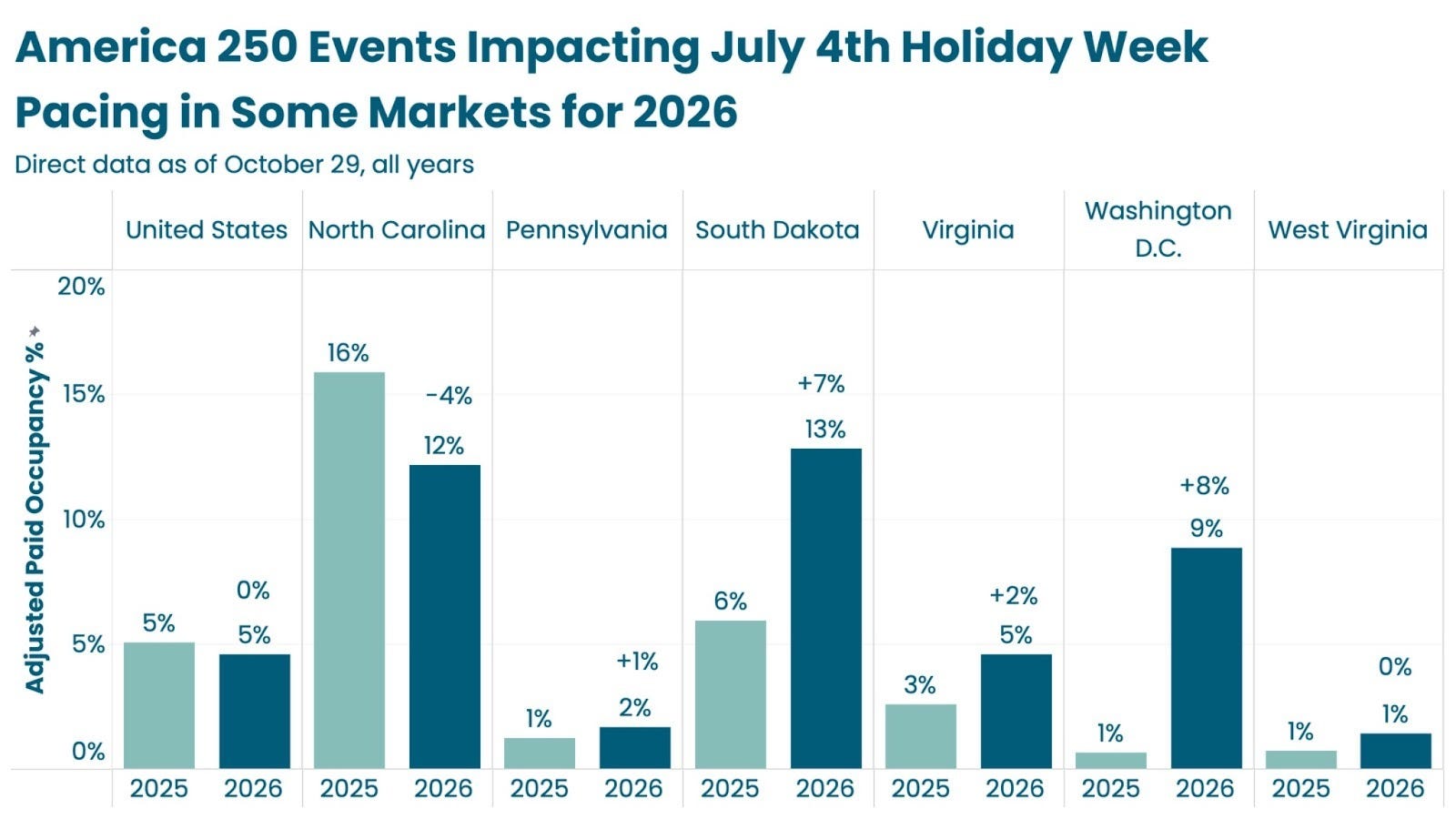
These numbers serve as a warning shot. Hotel pricing spikes by hundreds of dollars when you book late, and patriotic events will flood major metros with millions. Oh, and add in national‑park “America‑first” pricing and resident‑only free days, and you have a perfect storm of soccer ultras, history buffs, and MAGA‑RV caravans chasing flags and fireworks. Secondary cities and rural destinations will thrive if they stay authentic. (Think powwows in Oklahoma, Route 66 car parades in Tulsa, and baseball‑history exhibits in Alaska.)
Conventions & Experiences: Kill the Beige Carpet, Please
Conventions are borrowing from leisure because the old model is dead and everyone knows it. No one is flying three time zones to sit on patterned hotel carpet from 1998, wear a branded tote bag they didn’t ask for, and listen to the same keynote they half-watched in an emailed vendor webinar RSVP.
The bar has moved, permanently. Local culture matters. Food that’s actually good matters. Nightlife that exists matters. Outdoor add-ons matter. Plus-one itineraries matter. And every RFP now has an unspoken line item that says, “Does this city have a vibe, or are we gaslighting attendees into thinking it does?”
If you’re marketing for your Sales team, stop asking “how many placements did we run with MPI?” The real question is “what experience makes someone cross state lines, pay for dog boarding, childcare, overpriced airport beers, and still come home saying, I’m definitely going back”.
The “secondary city” moment is real (and it’s not just a cutesy trend term)
Priceline has been calling it “townsizing” - the surge in interest in smaller, more charming places over the biggest, priciest cities. Meetings & Events linked this directly to meetings positioning and cited that Gen Z is 89% more likely to seek a small-town vibe than a big-city trip.
This matters because planners are doing the same math that our leisure travelers are doing. Costs are up, attention is down, and if the destination experience doesn’t add something, it’s harder to justify the trip.
So, guess what people. You get a new competitive advantage opening up: secondary cities and smaller destinations can win only if they package it well and remove the friction.
My hot take (said nicely):
A lot of destinations are still selling meetings like it’s 2016… while attendees are shopping like it’s 2026.
Open your inbox or the Corporate-Meetings-Digest-Today-Whatever that landed in your mail pile. Now open it, and look at the ads. Stock-looking photos. Same fonts everywhere. Lame buzzwords. Zero reason to leave home. We can do better. And honestly, we have to.
The funding squeeze is not hypothetical… and it’s going to force a major strategy upgrade. And quick.
Destinations International’s DestinationNEXT 2025 Futures Study found 42% of destination org respondents reported their funding is at risk in the next three years.
DMO leaders, you already feel it. The era of “trust us, tourism matters”-type advocacy is being replaced by “prove it, quantify it, did it work, and can you put that all into three, 72pt font-sized bullets for the council agenda?”
What having your narrative coherence cocktail actually means is this: a story you can tell when the pompous, pontificating board member cuts you off mid-slide and says, “Okay, but did any of this work?” It isn’t a brand guidelines/over-explanation of numbers. It’s avoiding that moment when your strategy collapses like Ryan Gosling’s Jenga tower in The Big Short. How are you able to calmly explain?
Most DMOs are still stacking impressions on top of reach on top of brand lift and calling it “strategy”. That’s how you end up doing interpretive dance in the board meeting. Governance matters here. AI Industry analyst Andy Thurai says it bluntly in a Forbes interview:
“They know it’s garbage in, garbage out. So, knowing they are feeding garbage in, would you feel comfortable using the decision?”
In other words, messy data = bullshit output. He was talking about enterprise AI, but he might as well have been talking about our piles of destination marketing data.
And the DestinationNEXT 2025 Futures Study reads like a warning label that if your teams can’t align on real metrics such as visitation, spend, length of stay, seasonality shifts and resident value, then don’t expect your board to care about your impressions.
I said as much in episode no. 61 of Brand Revolt’s CEO Adam Stoker and Visit Myrtle Beach President Stuart Butler’s Destination Discourse when talked digital coherence and governance. Winners in 2026 will be the DMOs that can pass the Whiskey & Coke Test: Simple, significant, not over-sweetened or complex. Connect demand to outcomes, and say it calmly and confidently.
AI doesn’t fix messy strategy. It just makes the mess faster
If 2024 was about experimenting with AI, 2026 is about whether your destination’s information can actually hold up under it.
AI assistants don’t create clarity. They reflect whatever data, structure, and governance already exists. And there’s no version of this where old spreadsheets and conflicting sources suddenly turn into revenue.
This is essentially the King Midas problem. AI touches everything and turns it into… more. More visible. More scalable. More confidently wrong if you let it. AI will happily optimize whatever you give it, just like the damaged, agreeable robots in Mitchells vs The Machines, belting “OKAY!” whether that’s clean, governed information or a half-maintained spreadsheet last updated by someone who left your organization in 2022.
According to a joint McKinsey/Skift survey of 86 travel leaders, only 4% of large travel companies mentioned AI in their annual reports in 2022, and by 2024 that number was 35%. Venture capital funding for AI‑enabled travel startups jumped from 10% of deals in 2023 to 45% by mid‑2025. Nearly 60% of executives credit AI with boosting productivity, yet the same report notes that most efforts are still pilots. So, there’s tons of lemons, but only drops of lemonade. Like training for a marathon while rippin’ cigs “for stress.” A+ for the enthusiasm, though?
And here’s the part that no one, for whatever reason, wants to say out loud. Over 90% of travelers say they trust AI-generated travel recommendations, but only 2% actually let AI book anything. AI trust in travel is super weird right now. People trust AI to advise them, but they absolutely do not trust it to act. 90% vs. 2% is a gap the size of fucking Alaska.
On the other side of the table, 78% of organizations claim they’re using generative AI, while over 80% report no meaningful business impact. Which tells you exactly what’s happening here: we stapled AI onto messy systems, called it “innovation”, and then acted surprised when it didn’t do shit.
And here’s the part we’re not saying loudly enough yet: the destinations that will win in 2026 won’t be the ones screaming the loudest with their big bold summer media campaign, or spending the most. They’ll be the ones whose information architecture is so boring, so accurate, and so trustworthy that AI assistants can confidently recommend based on verified, structured information. Because let’s be real: visitors aren’t starting with your website anymore. And frankly, it’s been a while since they have. Visitors are starting with chatty little robots that don’t care about your homepage carousel or your $75K+ agency-led brand video from 2024.
If your visitor center hours, events, fees, accessibility info, and “things to do” content aren’t structured in a way an AI can understand and trust, you’re not being skipped. You’re being ignored…which is worse.
Practical moves (aka: what I’d “circle back” with my team on)
If this all feels painfully accurate and you’re about to jump into a meeting that could’ve been an email, good news. You don’t need another framework.
Here are the plays I’d run:
Rebuild your meetings pitch as a leisure-adjacent experience pitch.
Not fluff. Actual, shippable attendee add-ons: Plug in curated half-days, local tracks, micro-adventures, plus-1 itineraries, and your local partner activations happening while they’re in town. (And for the right audience, of course. A Metallica cover band is not your opening pitch for the Rotary Club.)Make a “secondary city advantage” deck.
Stop calling yourself cheap. That’s loser shit. Instead, pitch ease, experience, and quality. Data-driven moves and value replaces discount language.Treat funding risk as a product requirement, not a fear.
If 42% are at risk, your job is more than selling your destination. Your job is to show outcomes and calmly own your narrative. The Whiskey & Coke Test.Build an AI-ready destination knowledge layer.
This is the new table stakes. Clean data, structured content and clear governance. Visitor hours, events, fees, accessibility, and itineraries all nicely organized so an AI assistant can confidently recommend you. If your destination only exists as flattened PDFs, fluffy blog posts and ✨vibes✨, congrats: you’re invisible to how trips are actually being planned.Get ready for 2026 surges.
World Cup halo effect, America 250, election-year... even non-host cities can win if they package pre/post itineraries and show up in the consideration set. Last-minute is out of the picture.
Bottom line: people will travel when it’s worth it. Restorative leisure wins. Obligatory work trips are still getting side-eyed by CFOs.
Build experiences that feel personal, human, and easy. Or watch another destination take the wins of the year while you’re still polishing the slide deck.

This ran first on Signals
Emily writes weekly on AI, discovery, and what it does to destination marketing. Subscribe and it lands in your inbox before it lands here.