Your Consideration Set Is Being Rebuilt in Real Time. DMOs Measure It Once a Year.
Reach was always purchasable. Specificity never has been. This may be the most level our playing field has been in twenty years.
Emily Zertuche / July 30, 2026 / 16 min read

Happy almost Friday, what a WEEK. Who else needs a nap?
Okay, either try this out this evening, or you’ll know what I’m talking about.
Open any travel technology feed, any trade newsletter, any conference agenda from the past two years, and count how many of the AI stories are about booking. The new agent that books your flight. The announcement of an assistant that reserves your room. Which OTA gets disintermediated, and when.
Now, count the stories in these sections about traveler discovery, and the work on how a person decides where to go in the first place. Not much there.
That asymmetry is a problem for us specifically, and I really don’t think there are enough of us talking about it yet. A DMO has rarely, or never, controlled booking (and godspeed to those of you with booking platforms on your CMS). We don’t take the reservation. We don’t own the inventory. Our entire function sits upstream of the transaction, in the part of the journey where a person is still deciding whether we are even on the list.
Disruption at checkout is not our circus. Disruption at discovery? Now, THAT, we own. We have spent the past three years, and now almost daily, on the ‘AI in travel’ news that doesn’t fully bring us into the conversation just yet.
The short version:
A destination consideration set (the shortlist of places a visitor is choosing between) has always been measured through brand studies that field once or twice a year and report a month later. Those studies still matter. What has changed is that AI is now used more to choose a destination than to book one, which moves the disruption from the booking funnel to discovery.
And discovery is the DMO’s job.
Have We Been Bracing For the Wrong Disruption?
Just today, Longwoods International and Miles Partnership’s American Travel Sentiment study graciously entered my LinkedIn feed. Among travelers who used AI to plan a recent trip, 29% used it to determine which destination to visit. 21% used it to book. Booking ranked last of the ten uses tested, behind finding attractions, ideas and trip itinerary planning. Booking is still the last thing people reach for AI to do. Deciding where to go is near the top.
That is the consideration set. That is the thing we exist to influence, the thing our brand campaigns are built to move, the thing we report to a board every year. And while the industry watched the bottom of the funnel for the robot that books hotels, the top of the funnel was being rebuilt inside a LLM app.
There was no sexy product launch for this, and nobody really announced that destination discovery had moved, we sort of just started feeling it when our website numbers began declining. And it happened by one conversation at a time, in a text box, in a few million kitchens.
For Twenty Years, We Knew Where We Stood
🚨 Before I go further, a big and important statement: annual brand tracking is not obsolete and I am not telling you to cut it.
I signed on to brand tracking. I used it to inform annual leisure campaigns and budget strategy. I defended the line item in rooms where it was the easiest thing to cut.
And let me say precisely what it is, because the argument I’m about to make only holds if I’m fair to it. For most of us, brand tracking is a survey study fielded in our target markets. We ask people whether they saw our advertising, what they think of the destination, whether they would consider visiting, and how familiar they are with us in the first place. Ad awareness, perception, familiarity, intent. Then we read the aware group against the unaware group, and the difference between them is our brand lift.
Brand lift is a real and very important KPI. Showing a board that your destination is holding position against a comp set is a real job, and a well-run study is still the instrument that does it. The fact that the sharpest read on this shift came out of a syndicated tracker rather than a technology company tells you how much that discipline still matters.
What that system rests on is one assumption that held for two decades:
There was one consideration set, it moved slowly, and a representative sample could describe it.
Every part of that sentence is now doing something it wasn’t doing in 2023.
We Need to Talk About Vickie
let’s talk a little bit about personas and the creation of these.
Personas exist because we could never know the actual visitor. We could not see her. We bought segmentation studies, clustered the psychographics, and invented composite fictional people to stand in for a few hundred thousand real ones.
I dug some that I did back in 2018. My team at Visit Corpus Christi ran a persona workshop, one persona per drive market, and I sketched them on a whiteboard, putting the drawing straight into our deck, which I still maintain was the correct call at the time. Very important work. (These were retired in 2020 but hey, let’s get nostalgic here!)

Meet Vickie, San Antonio. Female, some college, married, no kids, over $75K. Her husband is 42 and is a middle school football coach and social studies teacher. She likes margaritas, TJ Maxx, movie theaters and fast casual dining. She is Type A. She has perfect nails and never misses her appointment.
There is Daniel from the Valley, trade school, oil and gas, two kids aged six and eleven, whose wife loves Michael Kors and who appreciates a discount but will not ask for one. Jordan from Austin, 32, UT grad, rescue dog, owns a Jeep, vegan-ish, heavy on Instagram. Megan from Houston, who drives a Jetta, quotes movies, and thinks Corpus “is chill”. Kevin from Dallas, whiskey and water, who is convinced we are twelve hours away.
I love them. I still love them. What simple times.
A persona is a conjunction. Age band and income band and education and party composition and vehicle and music taste. Every attribute you add multiplies the population that genuinely matches all of them at once, downward, fast.
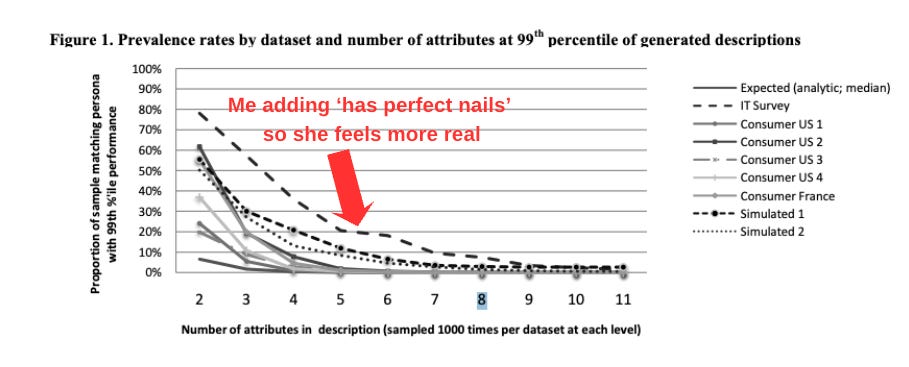
Researchers generated 10,000 persona-like descriptions across six real survey datasets and checked how many actual respondents matched each one. Even at the 99th percentile, the best descriptions they could build, a persona “fails to match anyone when 9 or more attributes are combined” in five of the six datasets, including every consumer dataset.
Vickie carried sixteen. Kevin carried sixteen. Jordan and Megan carried twenty apiece.
Past nine, the research says a persona in a consumer dataset matches nobody. Not “very few people.” Nobody. Every specific, delightful, hand-drawn detail we added to make her feel real is a detail that made her less likely to exist. We were rewarding ourselves for precision that was only ever narrowing.
And many of us are still doing it. In Sojern’s 2026 study of DMOs worldwide, 74% named demographic data as their dominant targeting input.
Then I noticed something on the second read of this.
Every one of those persona people has a second half. Next to the fictional person is an itinerary. Jordan’s reads: SUP paddleboarding, beer yoga at Nueces Brewing, dinner at Costa Sur Wok, the turtles, brunch at Hester’s Cafe, the Art Museum of South Texas. Daniel’s reads: Texas State Aquarium, fishing, four-wheeling on the beach, Snoopy’s, Panjo’s Pizza, and Concrete Street if the kids aren’t along.
Those are real, named, checkable places, tied to who they are for and when. That is exactly the material an AI answer gets assembled from. So why did we build these fictional characters and put so much time and effort into their demographic nature when all along it’s the itinerary that’s carrying the most importance?
The system on the other side of the table does not need a persona. It already has the person.
LLMs know her kids’ ages because she mentioned them. It knows she hated her last beach trip because she complained about it. Researchers pulled apart 2,050 memory entries from 80 real ChatGPT accounts and found 96% of those memories were written by the system on its own initiative rather than saved by the user, with psychological inferences about the person in 52% of them.
We are bringing Vickie to a conversation where the other party has the real woman, her real husband, and the trip she took last spring.
Twenty years of segmentation decks, and the system that ate our discovery layer did better audience research by accident, in the background, while somebody asked it where to get dinner. Shit.
Before anyone decides the fix is to let AI generate the personas instead, a study published not even two weeks ago tested synthetic survey respondents against 3,000 real people. The synthetic data tracked change between study periods about 47% of the time, which is basically a coin flip (lame). Manufacturing the fiction faster is not the answer.
But this is where it gets fun, and it’s why I’m writing a happy, puppies and rainbows optimistic post instead of a doom one.
If the system already knows the visitor better than we ever could, then knowing the visitor stops being our advantage. It was never really ours. What’s left is the half that was always genuinely ours, and it turns out to be the half that’s now scarce.
They have the demand side. We have the supply side. Nobody knows our destination but us.
Which Is Why Portland Kept Coming Back to The Most Important Topic: Storytelling.
Nearly 2,000 of us were at the Destinations International convention last week. DI keeps earning that room, and with Future Partners they released the “Destination Reputation: Impact on the Traveling Consumer’s Considerations” study, which is exactly the question this issue is circling.
Our industry has constantly provided the advice to “tell your story” the way it says “be authentic.” (Micro-story time: I remember at one DI, there was a question from the audience, and they asked the speaker to describe what “being authentic” meant, and they literally could not answer the question. It became a running joke.)
This time, it was refreshingly different. It’s now the most concrete, most technical advice you can now give a DMO.
An AI answer gets assembled from whatever specific, retrievable material exists about a place. Specificity is the raw ingredient. Asked to name somewhere for a long fall weekend with teenagers who hate hiking, a system has to reach for something concrete: a particular stretch of water, a named festival in a named month, the thing your community is genuinely known for by the people who live there.
I used to tell people to strike “hidden gems” and “off the beaten path” from destination copy on the grounds that the phrases are meaningless. That advice is half wrong, and the wrong half is the important half.
People ask in category language. Somebody types “what are the best hidden gems in Texas” into ChatGPT, in exactly those words. If the phrase “hidden gems” appears nowhere in your content, you have opted out of the category that query belongs to. The words are the door. You want the door.
What fails is a door with no room behind it. “Discover our hidden gems” followed by nothing is a page that matches a category and then has nothing to hand over. “Hidden gems” followed by a named spring-fed swimming hole an hour outside Austin, best in April, that locals genuinely drive to, is a page a system can pull a real answer out of.
Use the category words. Then earn them in the next sentence. A system trying to distinguish your destination from forty others cannot do it from language that would fit all forty, but it also cannot find you if you have refused to speak the language of the question.
That is one hell of a thing to be handed. For twenty years, being in a consideration set was substantially a function of budget. Reach was something you had to buy. A destination with 10X your media spend appeared ten times more often, and being genuinely more interesting did not fix that.
But guess what people. Specificity is not purchasable. You cannot buy having a real thing to say.
There’s evidence for the opening, too. A research team of student badasses generated 6,480 destination recommendations across 216 traveler profiles and found that how often a destination got recommended correlated only weakly, and not significantly, with its measured tourism competitiveness. Most could read that as bad news. I read it as amazing news.
If the shortlist doesn’t track underlying competitiveness, those positions weren’t earned and they aren’t defended. A ranking that isn’t earned on merit is a ranking with lots of room in it.
The sea of sameness in our industry has annoyed me my whole career, mostly on aesthetic, CMO-brain grounds. It’s now a measurable liability, and I find this sooo sweet.
How the hell do I measure this stuff?
These systems don’t return the same answer twice, even to the same person, and that isn’t a bug someone is fixing. One study found that even at temperature zero (nerd talk for the setting meant to make output as repeatable as possible) exact repeats of a prompt produced different outputs in about 24% of runs. A July study of 12,933 AI responses found that for any single answer, brand-ranking reliability sits near .01%.
Yep, near zero. I did this exact thing for months when first attempting to understand this world: typing your destination into ChatGPT once and screenshotting the result is not measurement. It’s one card off a shuffled deck, and tomorrow’s card is completely different.
Which is genuinely freeing, and I want you to feel how freeing I feel! 😀
The next time a board member forwards you a screenshot at 11:47pm on a Tuesday night with the subject line “we’re not on here???”, you do not have to spiral. You do not have to open the laptop. You do not have to draft a response that begins “great catch!” The honest answer is that it’s one answer, and one answer moves, and you can go back to bed.
The same courtesy applies to the screenshot where we look incredible, which I know is the less fun half of this.
Measuring it properly means asking many questions, many times, across many systems, and reporting only what survives the variation. It’s also why a brand tracker can publish a margin of error and an AI reading can’t: sampling theory works on human beings, not on a system that won’t repeat itself. When looking at any AI trackers, keep this part in mind when asking about the methodology behind this. I can nerd out all day about this part.
Five Plays
1. Keep brand lift studies!!! Add a second read beside it.
Both instruments are measuring your consideration set. They are just measuring different halves of it. The study tells you where you sit in people’s heads: whether they saw your advertising, what they think of the destination, whether they would consider a visit. Your board needs that, your board likes seeing it, and it is not going anywhere.
The AI read tells you the part the study cannot reach, which is what gets assembled when somebody asks a system where to go and a shortlist appears in seconds. If you need one sentence for the board, use this one: More people are now using AI to decide which destination to visit than to book a trip, so this belongs to our discovery and intent to travel part, not the booking channel’s.
2. If a brand refresh or an agency RFP is anywhere on your next 12 months, put this in the scope now.
That is the moment the audience work gets defined, and it is far easier to ask for behavior and real specifics up front than to relitigate a persona deck in month five when it is already in the brand book. If you only change one line in that scope, make it this: ask what your visitors are asking, not who they are.
3. Audit one page of your own copy for sameness.
Take your top landing page and mark every phrase that would fit any other destination. Unforgettable. Hidden gem. Something for everyone. Rewrite one section with names, months, and specifics only your community could claim. Two hours, no budget, and it improves the page for visitors and for the systems reading it.
4. Ask your biggest partners what their sites are doing about AI crawlers, this quarter.
On September 15, Cloudflare begins blocking training and agent crawlers by default for new domains and free-tier customers on pages that show ads. Cloudflare sits in front of a large share of the web. Your destination’s answers get assembled from your hotels, your attractions and your local publishers, and some of that could go invisible.
5. Give your team 20 minutes a month with LLMs.
Not as a report, as literacy. Have people ask real visitor questions, unbranded, and bring back what they saw. This is what lets you evaluate vendors, brief your board, and notice a change before it shows up in somebody’s number. Cheapest thing on this list, highest return.
I know how this lands when you’re already stretched. Another shift, another thing to learn, another line to defend in a budget that didn’t grow. I’ve sat in that chair and it is genuinely hard.
But, alas, there is hope.
For years, being findable was mostly a function of what you could spend, and the small destination lost that fight before it started. What’s replacing it rewards being specific, being real, and knowing your own community well enough to say something no other place could say.
They have the visitor. We have the destination. Only one of those is scarce now, and it’s ours.
Q&A time! Inspired by real DI Portland convos last week
Q: Are visitors really using AI to choose where to go, or just to book?
A: Choosing, and it is the half we keep underestimating. Booking is the easier thing to picture, so that is where the industry conversation went. But, the research on destination recommendation is all about the choosing. Recommendation frequency correlates only weakly with a destination’s measured competitiveness, which means these systems are actively building shortlists rather than executing a decision somebody already made. Future Partners puts AI trip-planning usage at 30.2% of American visitors, up from roughly 24% a year earlier, and highest among parents of school-aged children.
Q: Do audience personas still work for AI-era destination marketing?
A: Personas were built to mentally model an individual visitor a destination could never observe directly, and research shows that past roughly 9 combined attributes a persona often matches no real respondent at all. AI systems now hold detailed individual profiles, largely assembled without the user’s involvement. What a destination still uniquely controls is the supply side: specific, accurate, current information about the place itself, which is the raw material an AI answer is built from.
Q: Can we influence what AI says about our destination, or is it a black box?
A: Neither.
And the most common question I got all week. You do not control the model and there is no ranking to game. What you control is the evidence these systems assemble an answer from, and that evidence is not just your website. When somebody asks where to stay or what to do, the answer gets built from your hotels, your attractions, your restaurants, your local publishers and you, all at once. That is why a tool watching one domain is watching one exhibit in a case being argued from twenty, and it is the specific problem we built Zertura to solve: we read six named AI systems, we weight heavily toward unbranded discovery questions rather than your own name, and because these systems do not repeat themselves, every question runs many times so a real change can be separated from ordinary variation. When something cannot be measured well enough, it reports as absent rather than as a low score. You do not have to get that from us. You should demand it from whoever you do get it from.
Q: Why isn’t checking Claude/ChatGPT once a month good enough?
A: Because these systems are non-deterministic. Even at “temperature zero” exact repeats of a prompt produce different outputs in roughly 24% of runs, and one study of 13K responses found single-answer brand-ranking reliability near zero percent. A single query is one draw from a distribution. Measuring means running many questions many times across multiple systems and reporting what survives the variation. Yay non-determinism!
(me when my husband puts me in charge of deciding dinner.)

This ran first on Signals
Emily writes weekly on AI, discovery, and what it does to destination marketing. Subscribe and it lands in your inbox before it lands here.