As If Tourism Didn’t Need More Acronyms
Ten new acronyms, one trustworthy answer key from Google, and the story of why I built Zertura.
Emily Zertuche / July 15, 2026 / 16 min read
Happy Pre-#DIAC26 week! ✈️
Always fun to get our travels in order for Annual, and if you’re attending in Portland, I hope to see you there.
Every DMO has the same onboarding ritual.
A new hire’s first all-staff standup meeting, and someone from your sales team announces that “NACDS is in town this week, and we’ve got SGMP’s RFP that in the pipeline for fall,”
…And you watch this poor person’s soul leave their body in real time. What language is this??
We’ve all had to institute the rule: say the FULL name of the convention group, then the acronym. Because we are an industry that communicates almost entirely in capital letters, and we’ve made peace with that. (I mean sort of, it’s still something to make fun of, shamelessly.)
Which is why I find it hilarious that the AI era looked at travel and tourism, an ecosystem already drowning in DMO, CVB, TPID, HOT, RFP, and OTA, and said: you know what these people need? Ten more.
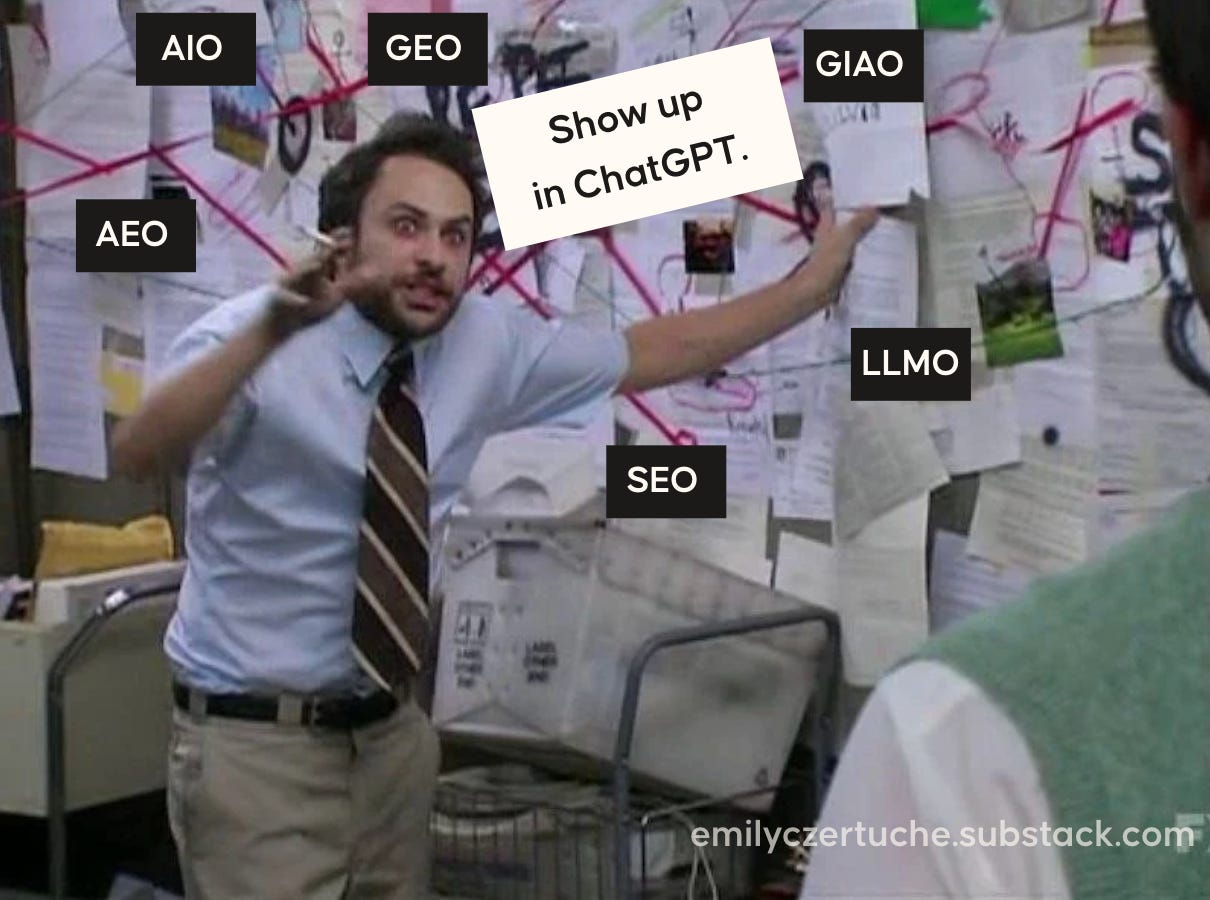
I counted. SEO, AEO, GEO, LLMO, AIO, GAIO, SGE, AISO, SXO, and E-E-A-T are all in circulation right now, all describing roughly the same anxiety. The webinars, the audits, the LinkedIn carousels, all of it multiplying weekly.
And my favorite detail, the one I’ll be repeating at every conference bar through 2027 is, there’s literally no agreed-upon distinction between most of them. Wikipedia itself notes that no consensus definition separating these terms exists. The people inventing the modern-day alphabet can’t agree on which letter it is.
I have real sympathy for where that leaves us. AI adoption was already confusing enough for a lean DMO team, and now the vocabulary describing it changes faster than a fiscal year. If you’ve felt like you’re behind because you can’t define GEO on command, hear me clearly: you are not behind. The definitions don’t exist yet. Nobody can. My hope is that by the end of this piece you’ll feel a lot less behind and a lot more annoyed, which, honestly, is the correct emotion here.
The short version:
AEO, GEO, and LLMO all describe the same goal: getting your destination named inside AI answers. Google’s July 2026 documentation confirms its AI features run on its core search ranking systems, and that llms.txt files, content chunking, and manufactured mentions don’t help.
What does: accuracy, distinct content, and measurement.
More on this in a bit to break this down on what it means for DMO website visibility.
But first, the teardown.
Say the Full Name, Then the Acronym
Same rule we use for convention groups. Full name first.
Search Engine Optimization. SEO. The one we know. Twenty years of working to rank in the blue links when someone searches “things to do in [your destination].” Still very much alive, and we’ll get to why in a second.
Answer Engine Optimization. AEO. The goal moved. The prize is no longer ranking in a list of links, it’s being inside the answer when a visitor asks ChatGPT or Perplexity “where should I take my family for spring break.” You don’t win a position anymore, you win a mention, or you’re not in the conversation at all.
Generative Engine Optimization. GEO. Fun fact: GEO actually came out of an academic paper in 2023 before the industry got hold of it. In practice, GEO and AEO are the same idea wearing different name tags. Both mean “please let the AI say our name.”
Large Language Model Optimization. LLMO. Yep it’s AEO again, but with more syllables and sounds more like the electronic duo from 2011 that blessed us with the Party Rock Anthem.
AIO, GAIO, AISO, SXO, SGE. Variations, umbrella labels, and one retired product name (SGE was Google’s beta name for what became AI Overviews). All describing the same want.
Experience, Expertise, Authoritativeness, Trustworthiness. E-E-A-T. The odd one out, because it isn’t a tactic and it isn’t as hype as these other techbrocronyms. It’s the quality bar from Google’s own rater guidelines, a description of content that was clearly made by a real person who has been to the real place.
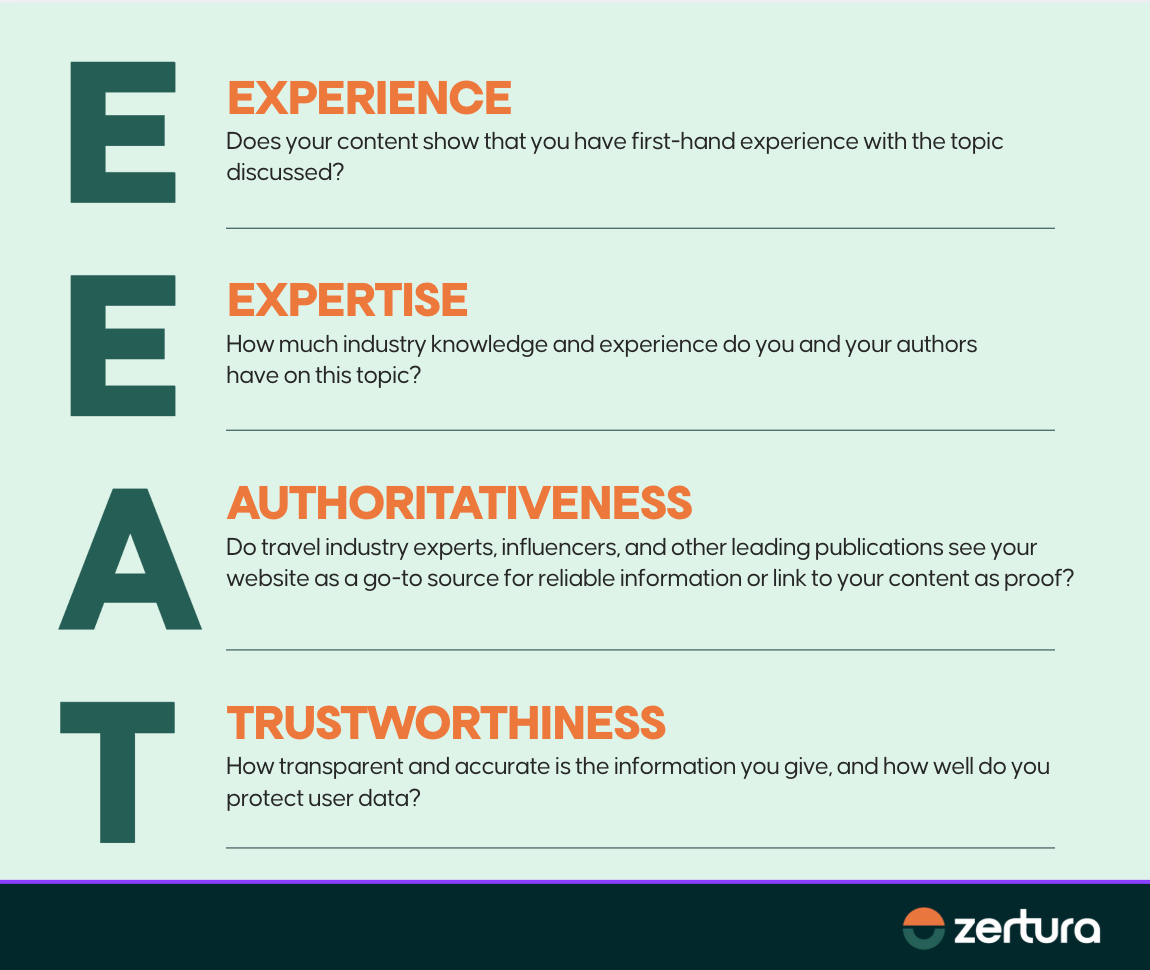
It’s genuinely useful as a lens for destination content, and worth 20 minutes of your content team’s next meeting. Search Engine Journal has a great walkthrough of how to demonstrate it (SEJ), and if you read it thinking about your destination, you’ll notice something encouraging: a DMO is practically an E-E-A-T machine. First-hand experience of the place? That’s our whole staff and every resident we know. Expertise? Decades of answering “what should we do with the kids on a rainy day” makes you an expert in things no algorithm knows. We have what this bar rewards. We’ve just never organized our content around it on purpose. So, YAY! There’s a win!
One old discipline, one genuinely useful quality bar, and roughly eight names for a single new anxiety. Now the clarifying part.
Google Graded Everyone’s Homework
On July 10th, our dark overlord Google updated its official documentation on how generative AI features in Search work and what site owners should do about it. I read the whole thing so you don’t have to, and it’s the platform itself, in writing, being about as direct as Google ever gets.
The load-bearing sentence:
“The best practices for SEO continue to be relevant because our generative AI features on Google Search are rooted in our core Search ranking and quality systems.”
The AI answers run on the same engine as regular search. There’s no secret side door, no special handshake, no separate robot to impress.
Then it gets refreshingly specific about what you can stop worrying about:
llms.txt files and special AI markup: “Google Search itself doesn’t use them... Doing so will neither harm nor help your site’s visibility or rankings.”
Chunking your content into AI-bite-sized pieces: “There’s no requirement to break your content into tiny pieces for AI to better understand it.”
Rewriting your pages in robot-friendly prose: not needed. The systems handle meaning and synonyms fine.
Chasing manufactured “mentions” around the web: “Seeking inauthentic ‘mentions’ across the web isn’t as helpful as it might seem.”
If your team has been stressing about any of those, consider this your permission slip to exhale.
*With one caveat, because I want to be real with you: Google’s answer key is Google’s. ChatGPT, Claude, Perplexity, and Grok each run their own retrieval, and the honest picture there is that the fundamentals still matter, just not nearly the way the hype suggested, which is great news for a lean team. No major lab has committed to llms.txt in production, and 2026 analyses keep finding that having one doesn’t measurably improve your odds of being cited anywhere.
What carries across every model is both a relief and unglamorous: let the AI crawlers into your robots.txt (each lab now runs separate bots for training and for search, and blocking the wrong one makes you invisible to that model entirely), keep your structure clean enough that a system can pull facts out of it, and be present in the third-party places these models genuinely trust. No more gimmicky crap. Just, the fundamentals.
While your team is in there, one more practical gift: your GA4 can show you this traffic already, it just hides it by default. AI referrals get buried under Referral or Direct, and there’s no native AI channel yet, but a custom channel group with a regex filter pulls ChatGPT, Perplexity, Gemini, and Claude visits into their own line, retroactively. Here’s the setup guide. It takes 10 minutes and suddenly you have a trend line for the board (Do we want them to see more numbers? Probably not, but still, great for some easy wins.). AI referral traffic just crossed 1% of all web visits industry-wide, with ChatGPT driving roughly 87% of it.
Small today, but you want the trend line starting now, not in a year.
One more thing before the numbers, because it needs saying: SEO still matters. A lot. If you’re wondering how the dark overlord makes its money, it’s ads on search, which means Google has every incentive to keep search central, and it’s working on exactly that. I’ll shamelessly admit I closed and reopened my Chrome for the first time in a month just the other day and got greeted by the new AI search bar. The experiment phase is over. It’s the standard now, and everyone’s going to be seeing a lot more of it.
I wrote about that shift and what it means for our strategy back in May, and everything in that piece has only accelerated. The blue links and the AI answer now live in the same box, running on the same systems, which means the boring fundamentals your team already knows how to do are pulling double duty.
What Google says works is almost insulting in its simplicity: unique content offering a point of view nobody else could have, and accurate, consistent structured data about your place everywhere it appears.
And packaging turns out to be measurable too, which is where the real (peer-reviewed!) aha lives. The same academic team that coined GEO tested nine content strategies across 10,000 queries and found that adding statistics, expert quotations, and cited sources boosted a page’s visibility in generative answers by 30 to 40%. None of that means writing in robot dialect. It means front-loading the answer, stating your facts with sources, keeping your dates fresh, and saying something distinct enough to be worth quoting.
A summary up top, the fun facts where a skimmer (human or otherwise) will find them, a page that answers the question it promises to answer. We already know this format. It’s how we brief a board! Recency, distinctiveness, and authenticity aren’t new virtues; they just started paying out in a new currency.
The Numbers You’ll Be Quoting at Your Next Board Meeting
Visitor behavior first. Phocuswright puts AI usage in trip planning at 56% of travelers, and 5W’s Q2 research found more than a third of U.S. travelers now begin their research with an AI engine rather than Google. Destination Discovery has moved. That part is settled.
Now the supply side.
Skift’s Data + AI Summit reported that 82% of AI hotel recommendations draw from OTAs and editorial media, while only 6% of hotels surface in AI results at all. Sit with what that means for the stewardship side of DMOs. If you run a destination organization, your residents, your partners, and your board are counting on you to keep the community visible and truthfully represented in the places visitors make decisions.
For those whose funding answers to a HOT board or a city council, it lands even harder: the metric that justifies the line item has to live where the visitors are, and right now the decisions are increasingly happening in a channel where 94% of the industry’s supply simply doesn’t appear.
Concentration compounds it. 5W ran traveler prompts across LLM platforms and found the top three brands in several categories capture more than 70% of all citation share. Their line:
“Loyalty is not protecting the leaders. Earned media volume is.”
One footnote worth noticing: that index ranked only airlines and hotels. A huge reason why I created Zertura. More on that later.
The mechanics of that concentration deserve a minute, and I wish more of us were talking about them on stage. A search results page had ten blue links and three ads, so being fourth was a fine place to live. An AI answer is a paragraph, and a paragraph has room for only about three names. There is no page two of a ChatGPT answer. And the prompts that decide our futures are the unbranded ones. Nobody opens an AI assistant and types your destination’s name; that visitor was already yours. They type “warm beach weekend with kids under $200 a night,” and either your community is one of the three names that comes back or the trip goes somewhere else without your board ever knowing the moment existed. Our comp set used to be the destinations that bid against us for the same convention. Now it includes whoever the model decides is similar, and the model has never gone through a sales mission. (And before anyone files this under “a leisure problem,” meeting planners plan trips the same way the rest of us do now.)
The uncomfortable truth. Your destination’s perception now gets assembled from a dozen surfaces you don’t manage: Google Business listings, TripAdvisor reviews, Reddit threads, earned media, paid coverage, YouTube videos, TikToks filmed by someone who’s never heard of your DMO. The models read all of it. None of it asks your permission, and most of it isn’t yours to edit. That’s a real loss of control and it’s okay to grieve it for a bit.
But, your website still matters enormously, just not the way we used to measure it. Simpleview and Granicus analysis, reported by PhocusWire, found ChatGPT made close to two million requests to destination websites in a single eight-day window, and roughly 45% of those retrievals hit individual listing pages rather than the homepage or the campaign page the board approved. The listings, of all things. Your website has become the source of truth the LLMs check against everything else they’ve absorbed, which means its job description changed: it needs to be the most accurate, most current, most easily pulled version of your destination’s facts anywhere on the internet. Less like a travel brochure and more reference desk.
Put it all together and something clicks: market share and answer share have decoupled. The destination with the most room nights is no longer automatically the one the model recommends.
Size doesn’t protect you. Loyalty doesn’t protect you. What appears to move citation share is exactly what Google said: accuracy everywhere, and content worth citing.
Which happen to be the two things a destination organization, with its residents and its partners and its community stories, is uniquely built to produce.
Free Traffic Was Our Zero-Interest-Rate Era
There’s a first-principles argument from the venture world: when money was free, a lot of mediocre companies looked brilliant, and when rates went up, everyone found out who had a real business underneath.
Free organic search traffic was our version of free money. For fifteen years Google handed the travel and tourism industry visitors at essentially no marginal cost, and it let a lot of us treat “the website” as a strategy rather than a channel. Now the free thing is drying up into zero-click answers, and the whole ecosystem, understandably, is scrambling for what replaces it. The scramble is where the ten acronyms came from, like from processing a shock.
But the first-principles question underneath the scramble is not “which acronym do we adopt.” It’s this: is the AI describing our destination, and is it getting it right?
Destinations Have Approval Ratings Now
I want to tell you why that question changed my life a little.
The way I finally learned to explain it, is polling.
Our industry has never flinched at measurement. We track ADR, occupancy, visitor sentiment, ad recall, economic impact. We poll everything we can reach. And somewhere in the last two years, without a press release, every destination acquired something like an approval rating inside the AI models: a live, shifting composite of whether the AI mentions us, describes us accurately, says something distinct instead of beach-and-sunset mush, and works from recent information instead of a 2019 blog post. That rating gets consulted millions of times a week by real visitors making real decisions. And almost nobody is polling it for DMOs.
I had a gut feeling on this dread before I could articulate it. Over a decade on the marketing side of a DMO, and the hardest fight of every budget cycle was defending top-of-funnel work, because awareness is the first line item a tight year comes for.
I sat in those rooms. I made those cases with the best dashboards, agency reps, and outside media partners we had, and I watched the case get harder every year as budgets tightened, right as discovery itself was migrating into the LLMs where none of our dashboards could see it. We were being asked to defend the top of the funnel with instruments that couldn’t observe where the funnel had gone. So this is why I decided to build it.
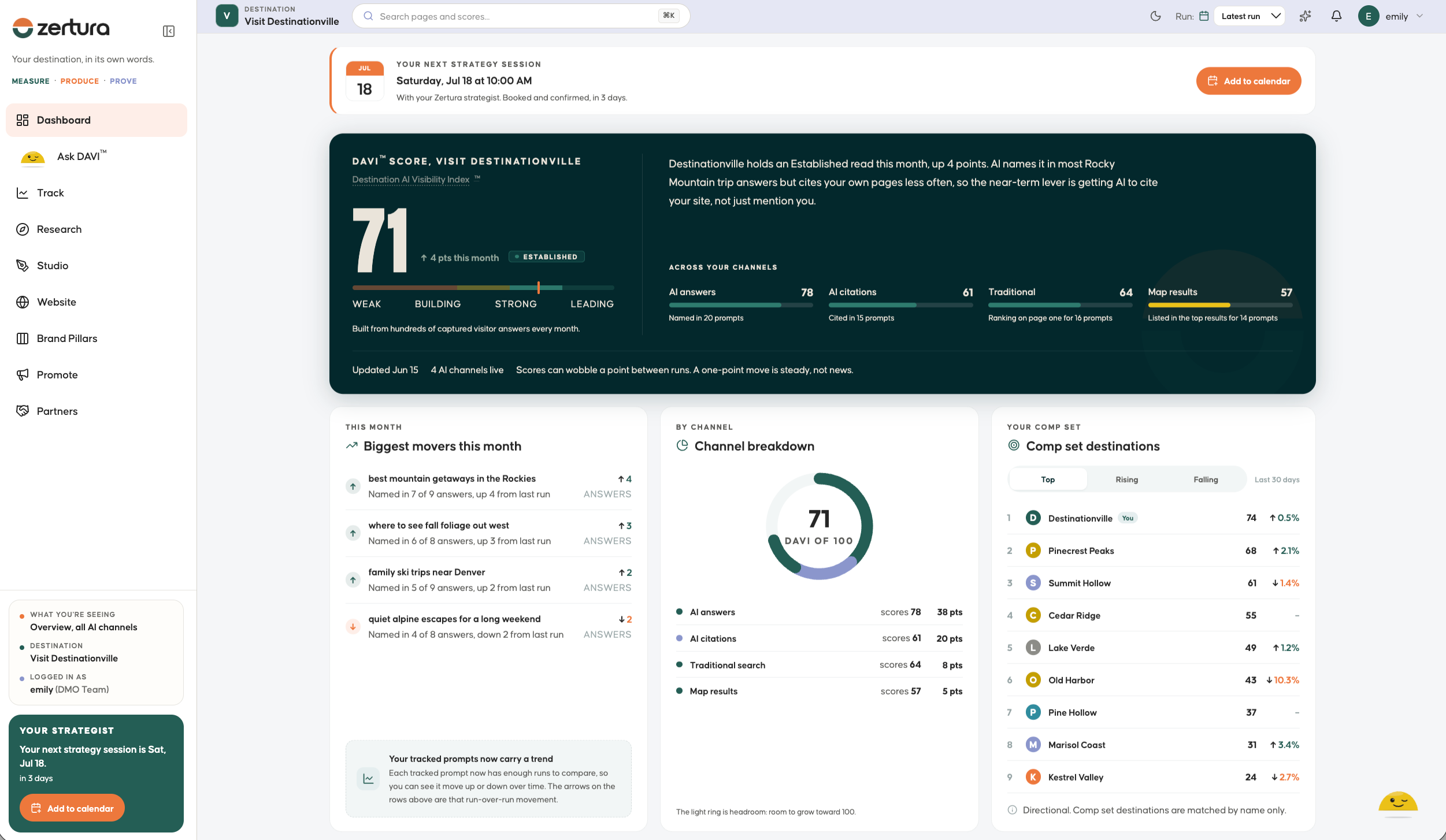
Zertura measures the top six AI platforms visitors use to plan trips, shows a destination exactly what those platforms say about it, brings in your traditional SEO, your website health, and rolls it into a single 0 to 100 score (we call it DAVITM, the DMO-focused Destination AI Visibility IndexTM that updates monthly, like a tracking poll instead of a one-time snapshot.
Is what the AI says about us relevant? Is it recent? Is it distinct? Is it true? Measured on a healthy cadence, so a marketer can act on it, a PR director can pitch against it, and a CEO can walk into a board meeting with a qualitative measurement instead of a vibe.
And it’s built for the whole community behind a destination, the hotels and attractions and restaurants, because the partner ecosystem should be a destination’s strength, not its weakest link.
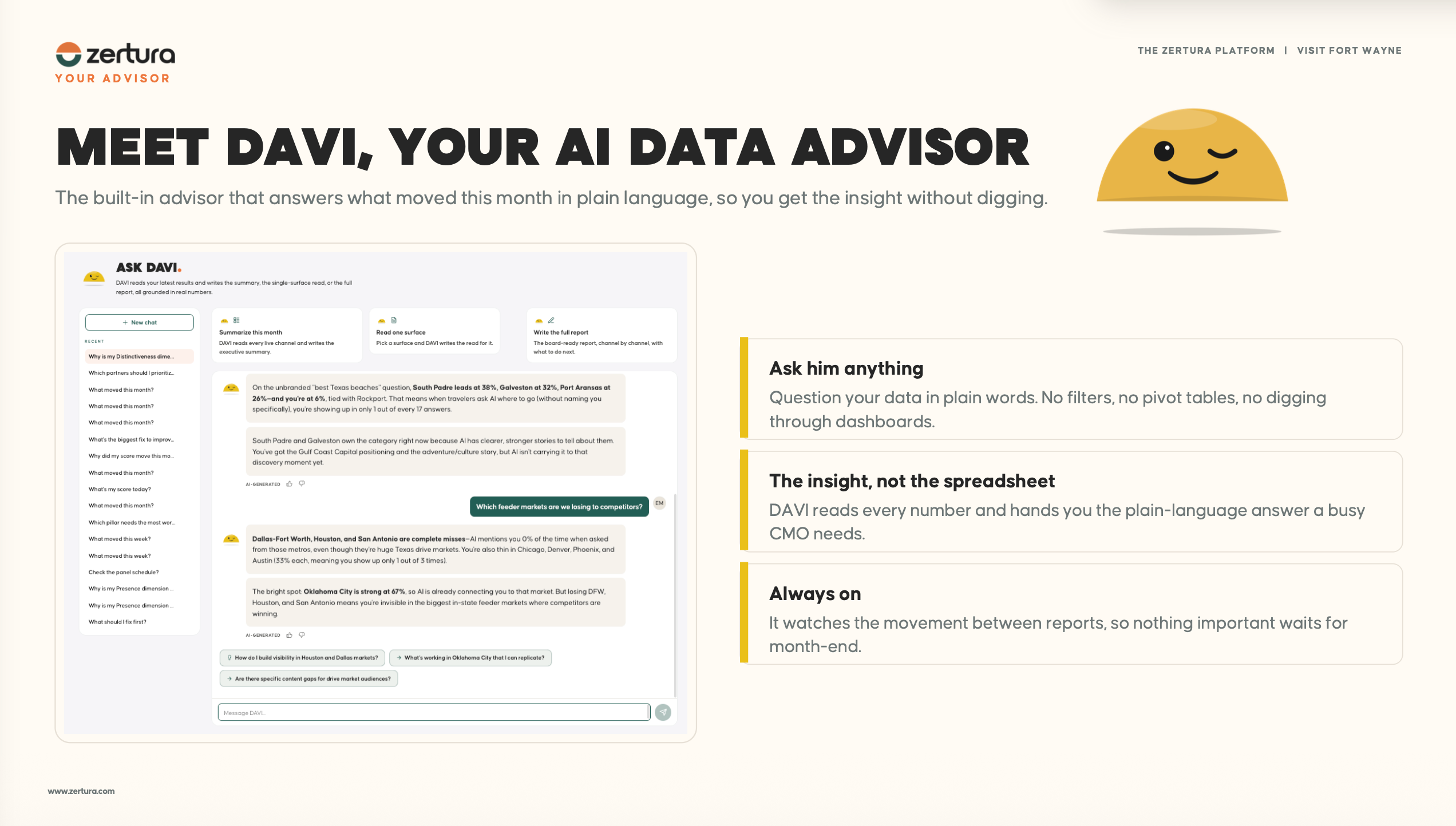
And, what’s an AI platform without a little character chatbot that you can use to ask just about everything you’re curious about with your data??? His name is DAVI. (Davey or Dah-vee? I keep switching, so you all tell me what sticks better, and we’ll stick with that.)
The platform is meant for providing a DMO’s partners a resource for them at no extra time or cost and lowest-hanging fruit you could give them in the new AI era. Zertura provides up to 100 partner logins at zero extra cost for an ability for them to be educated and see their monthly snapshot of where their business, attraction, restaurant, or event or hotel ranks in visibility and perception in the AI era.
The mission, and I mean this with so much of me, is helping all destinations win the AI transition without losing the stories that make them distinctive. We shouldn’t have to pay extra for that information.
(If you can tell, I’m extremely passionate about this. It’s my baby, and it’s something I always wanted when I was in the CMO seat.)
The future I want is one where AI describes every destination accurately, distinctively, and with the emotional truth a real visitor would recognize. I started this company because I love this industry, I’ve been in your seat, I’m still in your seat in every way that counts, and I couldn’t watch us navigate the biggest shift of our careers without the right instruments. I also do free AI snapshots for any destination that books a demo, even if you’re already set for the year in your budget. Schedule time with me, and we can just talk through it.
Also because I want to be genuinely useful here: Google now gives away a slice of this measurement free in Search Console for its own surfaces. Turn it on today. Whatever you end up using for the rest, the important thing is that our industry starts asking the question.
Five Things to Do Before the Next Budget Cycle
1. Read Google’s doc, then share it with your team.
It’s free and short (Google Search Central). It will save your staff real anxiety about tactics they can skip, and refocus them on the two things the platform says count.
Audit your listings before your homepage, and bring your partners with you.
Roughly 45% of AI retrievals from destination sites hit individual listing pages. Then extend the same audit outward: your partners’ and stakeholders’ Google Business pages, their hours, their websites. The AI reads all of it as your destination. Convene the ecosystem; this is co-op work at its best.
2. Dust off your Wikipedia.
When’s the last time anyone checked your destination’s page? The models lean hard on it, and half our industry hasn’t looked at theirs since before the pandemic. Read it today. Flag what’s outdated. (Follow Wikipedia’s conflict-of-interest rules when fixing, but knowing what it says costs nothing.)
3. Fund what can’t be faked.
Earned media and genuinely distinct content outperform paid and OTA distribution in the citation data. Your residents, your locally rooted writers, your community’s weird and wonderful specifics are the moat. Advocacy for that budget line is advocacy for the destination itself.
4. Ask whoever’s newest to the DMO world to demo their trip planning.
Your freshest hire hasn’t absorbed our industry’s assumptions about how visitors find things yet, which makes them the most accurate visitor in the building. Watch them plan a real weekend away, start to finish. If your destination doesn’t come up, you’ll have your budget argument, and they’ll have earned a seat in the strategy conversation they should’ve had already.
The acronyms will keep coming. There’ll be a new one by ESTO, and I’d genuinely put money on it. Underneath every single one is the same job our industry has always had: be accurate, be worth talking about, and know whether the story being told about your community is true.
We used to just call that destination marketing.
If you’re heading to the Destinations International Annual Convention in Portland next week, come find me. Let’s grab a drink. 🥃
This ran first on Signals
Emily writes weekly on AI, discovery, and what it does to destination marketing. Subscribe and it lands in your inbox before it lands here.