Bye Bye Bye to the Website as Your Front Door
The AI disruption timeline DMOs are not ready for, and what to build before the window closes.
Emily Zertuche / March 6, 2026 / 19 min read

Let me take you back to 1999, when the internet was dial-up, frosted tips were somehow a choice people made voluntarily, and a college freshman named Shawn Fanning launched a little file-sharing app called Napster from his dorm room, and the entire music industry, the labels, the suits, the people in boardrooms that smelled like mahogany and bad decisions, collectively looked at it and said: this is a fad, kids will stop, we will sue our way out of this, no further questions.
They did not stop. You cannot sue your way out of a distribution shift, it turns out, and by the time the labels figured that out, iTunes had already restructured the entire economic model of music consumption, the CD was a zombie stumbling around pretending to be relevant, streaming was warming up in the bullpen, and the people who had the foresight to actually move on what they were seeing instead of lawyering up? Yeah, they are still standing.
Disruption is not an immediate, obvious thing in front of us. It instead shows up like a niche product, then a meme on X, then a Reddit thread your intern shows you, then suddenly you are sitting in a leadership meeting realizing your visitors are getting destination recommendations from a chat interface, and your entire content infrastructure was architected for a search engine that is no longer the front door to anything.
We are in the Napster moment for destination marketing. Right now in March 2026.
And I am saying that as someone who is living it, not just writing about it from the sidelines. You can be the label executive who responds by screaming about copyright infringement and hoping the courts sort it out, or you can be Steve Jobs figuring out what the next model actually looks like and building for it. Pick one, but pick fast.
Okay, So Here’s the Timeline
The AI industry just had what I can only describe as a very public, geopolitically turbocharged identity crisis, and somehow in the middle of all of that chaos, it became the most instructive thing that has happened for destination marketing since DI Summits had leaders speaking on stage telling a room full of DMO leaders that AI agents were going to account for over 80% of website traffic within a decade, and the collective vibe in the room was a very specific cocktail of fascination, low-key dread, and someone in the back row opening their laptop to add things to their strategic plan. I was feeling that too, by the way, and I know you were. And that was before the news cycle of the last two weeks basically decided to become an AI thriller.
Mid-February.
Anthropic updated Claude with longer context reasoning and what they are calling computer use, which means AI that does not just answer your questions, it operates, it takes actions, it books things, it handles things, it basically does the thing instead of telling you how to do the thing. That is not a chatbot upgrade. That is an agent, and the distinction is going to matter enormously to how visitors discover and book your destination in the next 18 months, so file that away.
February 28.
OpenAI published its agreement with the Department of Defense, including explicit hard limits around autonomous weapons and domestic surveillance, and then updated it again on March 2 with even more guardrail language after the internet collectively had a moment about it.
March 2.
Reuters reported that multiple U.S. cabinet agencies were directed to stop using Anthropic products and switch to competitors, citing a dispute over guardrails for defense and intelligence use cases, and the internet took that information and immediately turned it into content, because that is what the internet does now, at a speed that honestly should concern all of us a little. This is FINE.
Also March 2, and this one matters for the behavioral piece of this story - Anthropic released a memory and context import feature, meaning if you were fed up and wanted to leave ChatGPT, you could now bring your entire conversation history and preferences with you like you were porting a phone number. The migration door was not just unlocked, it was wide open with a welcome mat and a free tote bag from the travel trade show that nobody actually wanted (but everyone took anyway).
The result? Claude surged past ChatGPT on iOS App Store rankings, confirmed by EMARKETER citing Sensor Tower data, and social media declared a mass exodus with the kind of unhinged energy usually reserved for a celebrity cancel-culture scheme.
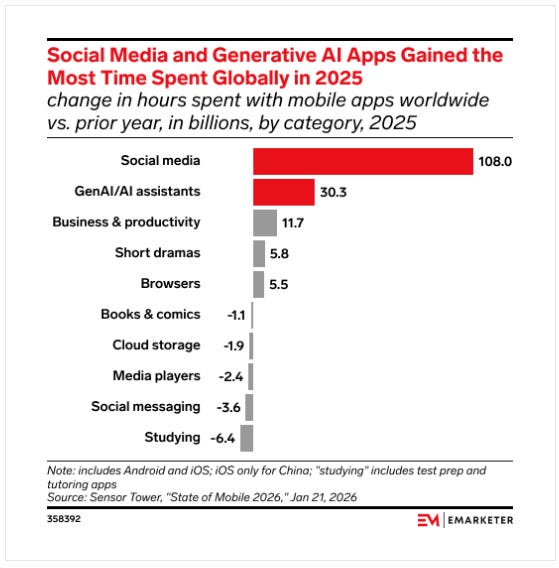
Is everyone actually abandoning ChatGPT forever? No. And that is a TikTok take we are going to leave on the floor. But… is this a trust migration event, where one feature made it frictionless to act on a political and emotional trigger tied to defense contracts and surveillance anxiety? 1000% Yes, absolutely. And that should matter to you because trust migration in AI platforms runs on the exact same human psychology as trust migration in visitor discovery. Same brain, different purchase decision.
The platform where your potential visitor feels safest, most informed, and most inspired is the platform where they decide where to go. That is your new competitive landscape and it has nothing to do with your website anymore.
Why the WW3 Memes Are Genuinely a Leadership Data Point and Not Just the Unhinged Internet

Memes are collective risk communication. When things feel genuinely unstable, people produce an entire genre of content that is simultaneously funny and deeply concerning and then send it to fifteen people in a group chat, because that is what we do with anxiety we do not know what else to do with. The WW3 memes did not blow up because people genuinely believe we are dead. They blew up because collective uncertainty is exhausting and dark humor is the oldest free therapy we have got, and it fits in a Reel while you are doomscrolling between checking what is on the books and answering a hotelier’s text.
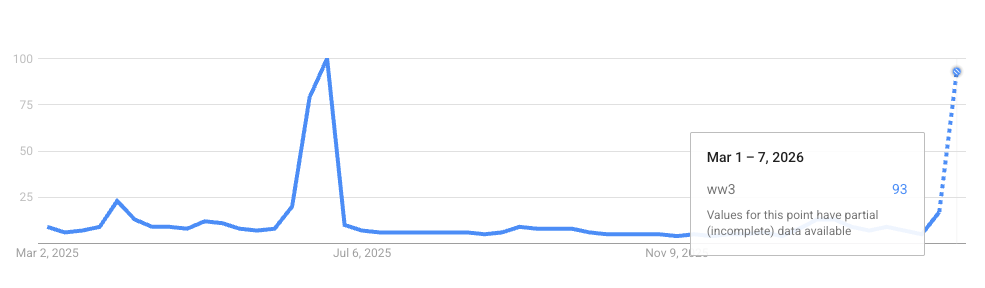
Your incoming visitors are researching a trip to your destination on the same phone they just used to watch a Reel about AI basically becoming Terminator 2, and that context does not disappear when they open a travel planning tab. So when you roll out new AI tools internally next quarter and get eye-rolls in the back of the room, before you call it a change management issue, ask yourself if you actually addressed the room. Did you say something real about what you are doing and what you are not doing? Or did you send a cheerful all-staff Teams email that said “exciting news, we are exploring AI integration” and call it communication?
Governance is not a compliance killjoy exercise. It is how you tell your team we are not the bad guys in this movie.
Your Actual Business Problem
None of us got into destination marketing to become AI strategists, and I say that with full awareness that I am literally writing an AI strategy newsletter to destination marketers right now, so the irony is not lost on me or on you, I am sure.
I got into this work because I genuinely love the intersection of data and creative and community, and because there is nothing quite like watching someone fall in love with a place you helped them discover. Still gets me every single time. I would never trade it for the world. But whether we feel ready or not, this is what is actually happening. Potential visitors are starting to get destination recommendations from AI instead of your website, and the number is moving in one direction only.
The AI Opener for Destinations initiative, which surveyed 311 destination professionals across 157 organizations in summer 2025, found that 99% of DMO professionals have tried AI tools and more than half are using them weekly, which honestly tracks with what I see in every industry conversation I am having right now. But the number that keeps sitting with me is the one living on the other end of all that enthusiasm: only 16% of those organizations have an actual AI strategy in place.
I said 16% last post and I am saying it again here, because it means something different now than it did two weeks ago. Last time it was about readiness. This time, after Criteo announced on March 2nd that it is the first ad-tech partner inside ChatGPT’s paid placement pilot, it’s about money, and specifically about the fact that the window between AI citation being free and AI answers being a paid media channel just got WAY shorter than we were planning for.
The DMOs that have been building content infrastructure for AI discoverability, the structured data, the GEO-formatted pages… those organizations will have something to stand on when paid placement becomes the norm. Everyone else is going to be reverse-engineering a channel they ignored when it cost nothing, against OTA budgets, in real time.
The front door to destination discovery has been our website for SO long that we architected literally everything around it: our content strategy, our SEO budget, our analytics stack, our conversion funnels, our STR occupancy attribution models, our staff roles, all of it built on the assumption that when someone wanted to figure out where to go, they typed in Google search and eventually landed on us. That assumption is eroding in real time, and I say eroding and not gone because the window to build the right infrastructure is still open, but it is not going to be open forever, and I need us to start talking about what we are building for instead.
The organizational readiness question is not just about your website. It is about whether your creative agency/team is talking to your marketing team, whether your marketing team is talking to your sales team, whether your sales director knows how AI is going to change the way a meeting planner searches for and discovers your destination before they ever fill out an RFP. It is about whether your communications team knows what sentiment is being generated about your destination on Reddit, on Facebook groups, in TripAdvisor reviews that are now being ingested into AI models as source material. It is about whether you have looked at your STR data, your ADR trends, your occupancy OTB reports and asked: are the visitors finding us, and how, and through what channel, and what does that tell us about where we need to be showing up.
Your website is not the front door anymore. And I mean this with love and also a little bit of frustration as someone who has been in the rooms at DI and eTourism and ESTO sessions watching this conversation get started and then not actualized by us: our industry has been incredibly slow to get ahead of this, and more often than not it is vendors leading the conversation in our LinkedIn feeds while DMO leaders are still figuring out what budget line this lives in.
No shade to vendors, they are doing the work, but we need to take our narrative back. We need to start doing the research ourselves. We need to stop outsourcing our strategy to the people selling us things and start building the infrastructure from the inside out. DMO leaders we are better than this.
What AI Is Doing to Your Content, and Why Your Web Team Needed This Conversation Like Six Months Ago
The Sojern 2026 report found that 64% of DMOs are already writing content specifically formatted for AI engines, answering specific questions, publishing lists, updating listings, and producing articles that align with real visitor queries. That means 36% of us are not and I know that number is being generous about what ‘formatted for AI engines’ actually means in practice because I have seen a lot of DMO websites and most of them were not built with a bot’s ability to extract facts as the primary design consideration. I know because I was one of them.
AI models do not admire your beautifully designed website. They strip the formatting, they extract the facts, and they move on with their lives.
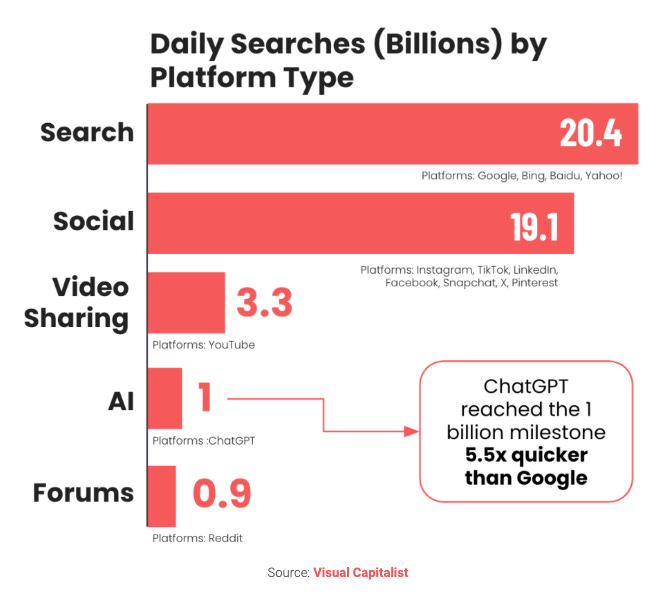
Your stunning hero image of the bay at golden hour with the couple holding hands in soft focus? The model cannot see it. Your beautifully crafted five-paragraph brand narrative about where adventure meets authenticity? Also largely invisible to a bot if it does not lead with clear, factual, extractable information, because that copy was written for a human eye doing a diagonal skim, and the AI is not skimming, it is extracting, and those are very different things. According to BrightEdge data tracked from February 2025 to February 2026, Google AI Overviews now trigger on nearly 48% of all tracked queries, a 58% increase year over year. For travel specifically, Noble Studios research found that social platforms are now generating 19.1 billion daily searches compared to Google’s 20.4 billion, and Gen Z visitors flip that order entirely: they start on TikTok before they ever open Google. And the Seer Interactive September 2025 study found that organic click-through rates dropped 61% for queries where AI Overviews appeared.
But the flip side is real and I want you to hold onto it: destinations that are actually cited inside AI Overviews see a 35% increase in organic clicks, and incoming visitors who arrive through AI-driven searches are about 4.5X more valuable than those from traditional organic because they have already done the comparison, they have already decided your destination is worth clicking on, and they arrive with genuine intent and a higher likelihood of converting into an actual booking which shows up in your ADR and occupancy, which is ultimately the conversation you are having with your PID board and your hoteliers anyway. The opportunity is real. It just requires a different kind of infrastructure than DMOs have built.
What actually works when an AI is reading your site:
• Factual summaries at the top of your pages, before the storytelling, before the brand voice, before the vibe. Lead with what, where, when, and why, then go poetic.
• Consistent naming, and I mean obsessively consistent: your destination name spelled and formatted the same way on every page, every platform, every press release, every hotelier partner page. No creative liberties.
• Structured data and schema markup. Pages with FAQ schema are 60% more likely to be featured in AI results compared to those without it. That is a free, implementable, this-week infrastructure improvement.
• Content that answers actual visitor questions, not the questions you wish they were asking. What is there to do. Is it family friendly. What is the best time to visit. How far is it from the airport. These are the queries AI models get, and your content needs to answer them plainly.
This is your GEO problem. Generative Engine Optimization. It is not replacing SEO, it is the next layer that gets built on top of SEO, and the honest reality is most DMOs have not started.
Meanwhile, the hospitality side is not waiting for us to catch up. According to a December 2025 hospitality trend analysis, an estimated 40% of hotel bookings are projected to pass through AI-driven environments by 2026, with major OTAs integrating directly into AI platforms so visitors can book without ever leaving a conversation window. And Expedia has been publicly explicit about treating AI as both a competitive threat and a distribution priority. They are not sending a task force to explore the landscape. They are at the table, and they are ordering their drink, and we are still looking for parking.
If the OTAs are already seated, you need to be there.
What We Are Doing at Visit Corpus Christi
We are five weeks into a 12-week AI plan at Visit Corpus Christi, and I am sharing this because a real plan beats a theoretical one every single time, and because if something goes sideways you will hear about that too. That is the deal.
What is done: AI policy attorney-reviewed and at the finish line, business plan and 90-day roadmap finalized, KPI framework built, CEO briefing delivered and aligned. Foundation is poured.
What is in motion: AI Readiness Survey launch, chatbot setup, GEO and SEO baseline audit, first team AI workshop, innovation lab launch, pilot selection, and prompt library version one starting with 50+ prompts, scaling to 200+.
The thing I most want you to take from that list is the order. Governance first. Baseline measurement second. Tools and pilots third. Content and scale fourth. Most organizations buy the tools first because it feels like progress, then realize six months in they have no policy, no training, no accountability structure, and no way to answer when the board asks what the ROI is. You know exactly what that meeting looks like.
Internal AI Council
We stood up an AI Council with representation across every department, Brand and Innovation in the chair, and Marketing, Sales, IT, HR and Legal, Finance, Operations and Visitor Services all at the table, because the decisions we are making about AI touch every single one of those functions whether they realize it yet or not.
The governance piece is not a small thing right now. The public conversation about AI in the news is literally about guardrails, about who is in charge of these systems and what the rules are. That is what your staff is reading before Monday stand up. If you do not have a visible, communicated, internal answer to those questions inside your organization, your employees are going to fill in the blank themselves, and the blank they fill in is usually nobody is in charge and there are no rules, because that is what humans do with ambiguity. This is especially true in orgs where your governance structure already has complexity, where you have a PID board, hoteliers who have a direct financial stake in your organization’s decisions, partner stakeholders across lodging, attractions, F&B, sports and events, and a city or county relationship that comes with its own set of accountability expectations. AI governance does not live in a vacuum in a DMO. It lives right in the middle of all of that, and the organizations that get ahead of it with a real policy and a real council are the ones that are going to be able to move fast without breaking things that matter.
Governance is not a constraint on innovation, it is what makes innovation sustainable. Print it. Put it in your next board presentation. It should be in every PID board deck that touches AI.
KPIs Because ‘Innovation’ Is Not a Metric
This keeps coming up in conversations I am having with peers and welcome the conversation. Innovation KPIs are not ~vibes~, not sentiment surveys, and they are not the number of AI tools you subscribed to in a fiscal year. They are operational readiness indicators, and if you cannot measure it, you cannot manage it, and if you cannot manage it, you are just spending money and hoping, which I understand emotionally but cannot recommend professionally. Here is the framework we are using:
Adoption. What percentage of your staff is using approved AI tools on a weekly basis, how many documented and repeatable workflows exist per department, and what is the time saved with a quality pass rate attached to it, not just time saved on paper. Time saved while producing garbage is not a KPI, it is a liability.
Governance. Policy completion rate, training completion rate, AI Council meeting cadence, incidents and near-misses logged and reviewed, and audit trails for anything that touches a high-risk output.
Discovery. How often is your destination cited or recommended when someone types a travel question into an AI assistant. What is your schema coverage on your top pages. Are you running a monthly baseline query test where someone on your team literally opens ChatGPT or Claude, types your city name plus a visitor type, and documents what comes back. That is your GEO report card and it costs you forty minutes a month and a willingness to face whatever the answer is. We do this at Visit Corpus Christi and it is humbling and clarifying in equal measure.
Service and experience. What is AI actually doing to your self-service visitor channels, what is the deflection rate, the resolution time, the satisfaction score, and critically, are humans still in the loop on the things that genuinely require judgment and relationship and context that a model does not have.
And here is the one tied to your STR and hotel data, because your hoteliers are going to ask: Are you tracking the correlation between your GEO visibility improvements and your occupancy? Are you seeing a change in ADR or booking lead time in markets where AI-driven visitor discovery is higher? TE/Symphony data, your STR reports, lodging tax receipts, these are the measurement systems that should be in conversation with your AI infrastructure investment because the whole point is positive EI for your destination. That is the golden question. That is the metric that matters to every single stakeholder in your ecosystem.
Sojern’s 2026 report found that 72% of DMOs now cite conversion and ROI as their primary proof points, and that use of AI for data analysis jumped from 28% to 51% in a single year. That is the industry moving toward measurement. The organizations building the measurement infrastructure now are the ones that will be able to answer the ROI question when it comes, and it will come, it always comes, usually from someone at a board meeting who is about to vote on your budget.
We are not in a keep-an-eye-on-it moment anymore. We passed that. The question is not whether AI disrupts destination marketing, it already did. The question is whether we as DMO leaders take back our narrative and build something real. Because here is what I am seeing too often: the same old same old. The good old boys club of best practices that were developed for a world that has already moved on. The conference sessions about AI that end with three takeaways and a sponsored cocktail hour and no accountability for what anyone is going to do differently when they get back to their desks on Monday.
That is not okay. I say that as someone who has been in those sessions, who has given sessions, and who is actively trying to do something different with the time and the platform I have.
The music labels lost because they did not own or even understand the new distribution channel until it had already lapped them twice. You do not want to be the best destination in your region and still be invisible because your content infrastructure was designed for a world that has already moved on. GEO. Governance. A team that knows how to use these tools. A data infrastructure that connects your AI investment to your STR reports, your hotel occupancy, your ADR trends, and your hotel tax revenue. And leaders who say out loud: we are building for where this is going, not defending what already existed. The window is open. It will not stay open. Do not sleep on this.
Five Things to Do Starting on Monday
1. Run the query test! Open Claude or ChatGPT (I mean do this right now), type your destination name plus your core visitor type, see what comes up, screenshot it. That is your baseline. It takes four minutes. I did this for Corpus Christi and it is what sent us into our 90-day plan and brand refresh (launching this summer and SO excited). Go find your version of that.
2. Audit your top 5 content pages with fresh eyes. Do they lead with clear, factual, extractable information? Or, do they lead with brand narrative that a bot cannot grab. Pages with FAQ schema are 60% more likely to be featured in AI results compared to those without it. That is a free, next week thing.
3. Put AI governance on your next leadership agenda as an actual agenda item with a draft policy in the room. Starting from a reaction to a draft is faster than starting from a blank page every single time. (DM if you’d to see ours, lawyer approved!)
4. Get an AI Readiness Survey out to your team. Know where they actually are before you build a plan based on where you assume they are, because I promise those are two different answers. I’ll be adding this survey to download the template next week, or DM if interested.
5. Start a prompt library with 10 prompts. The highest-frequency tasks in your marketing, content, and sales communications work that could use a documented, tested, repeatable AI workflow. Write them down, test them, share them across Teams. That is the beginning of something that actually scales.
The runway is real. The window is open. Frosted tips are, a choice.
And nobody is coming to save us if we miss it. So let’s not.
This ran first on Signals
Emily writes weekly on AI, discovery, and what it does to destination marketing. Subscribe and it lands in your inbox before it lands here.