The Airport Is a Dumpster Fire and SXSW Was a Lot. A DMO Debrief.
Godspeed at the airports. AI took over a third of SX sessions. Gas prices are a mess. We need to talk.
Emily Zertuche / March 26, 2026 / 12 min read
Happy Thursday industry friends. ☕️
Okay so. The airports right now. Godspeed to anyone traveling this month. Genuinely, I mean that.
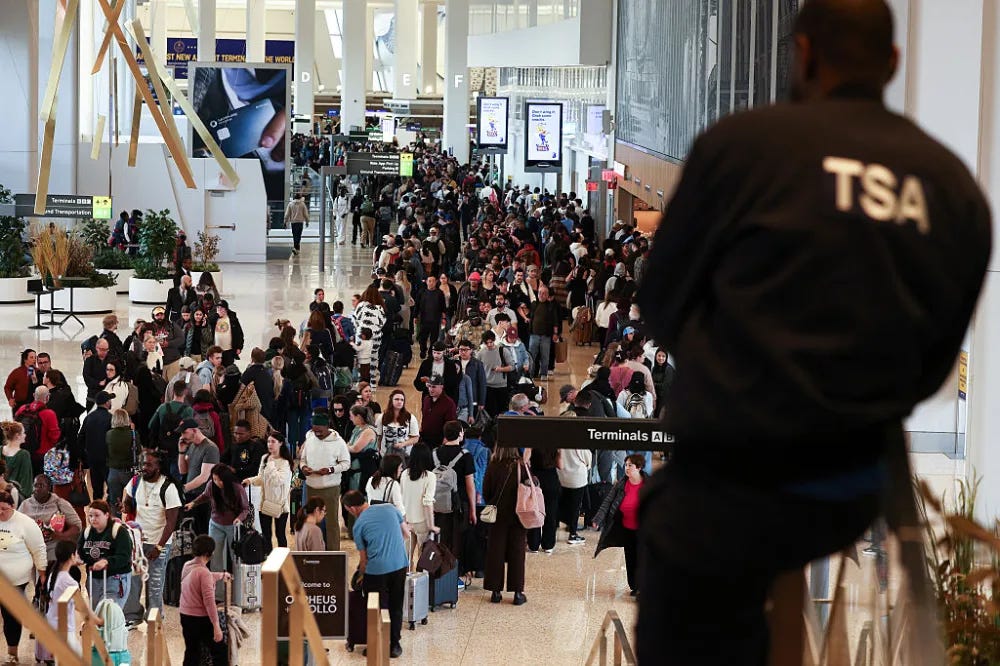
TSA officers haven’t been paid since February, over 400 have quit, and the administration’s solution this week was to deploy ICE agents in tactical vests to manage security lines at 14 airports — agents who are, by their own border czar’s description, operating on a plan that is “a work in progress.” Um sorry no it’s more like a fucking shitshow.
During peak spring break. At the world’s busiest airports. *Tucker Carlson voice* What-are-we-doing? What-are-we-doing? Also - Gas.

Totally fine, everything’s fine.
41% of TSA workers at Hartsfield-Jackson called out on Sunday. Houston’s Bush Intercontinental hit four-hour security wait times. LaGuardia had a fatal runway collision that shut the whole airport down over the weekend. And nearly 12% of the entire TSA workforce (more than 3,450 workers, mind you) didn’t show up on Sunday, the highest callout rate since the DHS shutdown started in February.
TSA is anticipating 6 to 10 million additional passengers for the FIFA World Cup starting in June and it takes four to six months to train a new TSA officer. Which means even if Congress funds DHS tomorrow, the new hires won't be ready in time for the World Cup.
I truly empathize with these people. It’s not okay. Are we okay here.
For us as DMO leaders, the thing to watch isn’t the politics. It’s visitor confidence, and travel confidence data has been consistent across every disruption cycle we’ve ever tracked: uncertainty about the experience affects booking intent faster than actual problems do. A visitor who knows there’s a delay can plan around it. A visitor who genuinely doesn’t know whether their airport is running normally or is a four-hour ICE situation starts doing the math on whether the trip is worth the uncertainty. Watch your spring booking pace weekly for the next 6-8 weeks… not monthly. Get in front of your airline partners with a real load factor conversation. And whatever creative is running right now, needs some awareness that the threshold experience of getting to a destination is part of the decision for a lot of people at this exact moment.

This will resolve…probably. The question is when. The only good thing happening in the world right now is the film adaptation of Andy Weir’s Project Hail Mary. I cried over a rock. Amaze. Jazz Hands!
SXSW. Year Eleven. Takeaways Relevant to Us.
SXSW is genuinely one of those events that is almost impossible to explain to someone who hasn’t been, because the outside perception is part music festival, part film premiere, part “Waiting in a two-hour line for cold, free, tiny breakfast tacos in a sardine-packed stomp-clap-hey venue with overpriced beer ” and all of that is accurate. There are people in lanyards. There are the freebie badge-less scoping all the unofficial parties. There are the Uber drivers who so confused about why downtown Austin is like this for days.
This year had tons of logisical challenges as the Austin Convention Center is literally a dirt patch right now, as part of a $1.6 billion redevelopment project called UnconventionalATX that won't reopen until 2029. The new facility will grow from 365,000 to 620,000 square feet of rentable space, run on 100% renewable energy, and become the world's first Net Zero Carbon Certified Convention Center. Austin CC Funded entirely through HOT revenues and convention center revenues with a projected $285 million boost to Austin's annual economic impact and 1,600-plus new hospitality and tourism jobs when complete. Tom Noonan and the Visit Austin team are essentially running a four-year long "trust the process" campaign while sitting on a giant hole in the ground, which, honestly, respect.
So South By ‘26 ran as a fully distributed citywide event with sessions across multiple hotels, venues and bars. For a conference drawing hundreds of thousands of attendees, pulling that off without a central hub is a real operational feat, and for us, it’s a reminder that world-class event experiences don’t require one big building.
(Austin pulled it off, kudos to all of them (ESPECIALLY CROWD CONTROL for Ella Langley) and of course the many, many volunteers.) I don’t know how they do it.
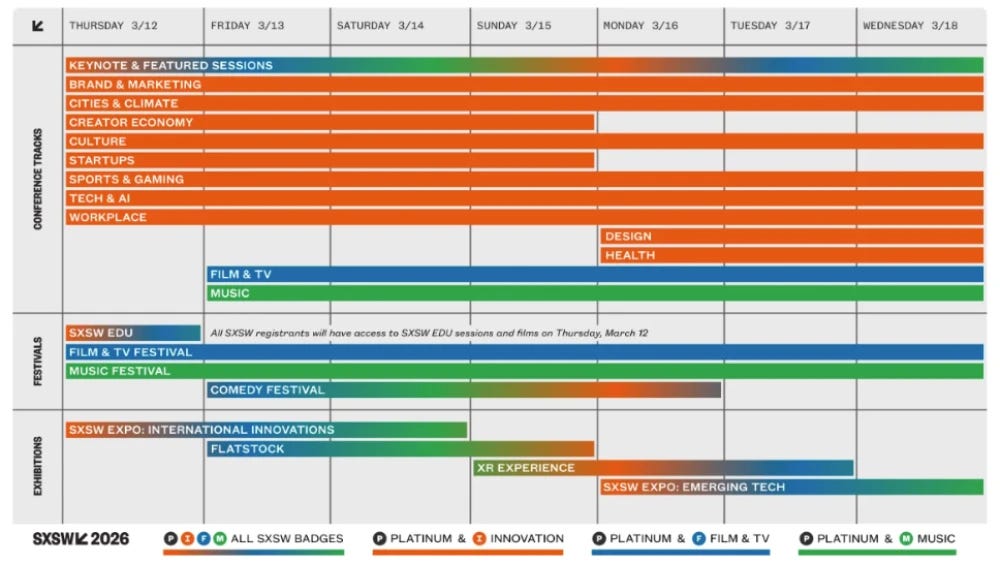
On the content side: nearly a third of all SXSW 2026 PanelPicker proposals touched on AI. Walking the Innovation tracks felt less like a technology conference and more like a full-industry reckoning with what is coming for organizations, for workers, for brands, for how visitors discover destinations, for all of it. The signal was loud and it was consistent across the Innovation track sessions I sat in, and the through line was the same every time:
Not one organization has this figured out. Not even the big dogs. The pace is accelerating, not plateauing, and the competitive advantage belongs to whoever is building the infrastructure right now while everything is still being constructed around them.
The Math Is Running Discovery Now (And Most of Our Content Strategies Were Not Built for This)
Dr. Rana el Kaliouby, co-founder of Affectiva, GP at Blue Tulip Ventures, host of the Pioneers of AI podcast opened the SXSW keynote with something that has been a little bit hard to shake. AI is ultimately complex math, she said. The danger isn’t anthropomorphizing it but underestimating the speed at which it’s remaking the underlying infrastructure of daily life, while everyone is still in the “are we sure about this?” phase.
For DMOs that infrastructure shift is visitor discovery.
Google is not our bestie anymore. Google is barely returning our texts.
When someone pulls up an AI assistant and types “where should we take the kids this summer,” that system is not pointing to our pretty website landing pages the way Google did. It’s instead synthesizing a representation of that place from the totality of how it’s been described, verified and published across the internet (like the entire internet) and if a DMO’s content is thin, dated, or written for an algorithm that no longer controls the room, it is simply not in that conversation. I know I’m a broken record on making this point but seriously. The difference from traditional search is that there’s no “page 2” to optimize your way back onto. This is Generative Engine Optimization — GEO and it is the most urgent strategic gap in destination marketing right now. Happy to help us all get our shit together.
The 10 Breakthroughs Shaping 2026 session at SXSW put some scale on why: ChatGPT alone is processing 2.5 billion daily queries. McKinsey estimates between $3 trillion and $8 trillion will be spent on AI data center infrastructure by 2030. The largest of those data centers will require more than a gigawatt of electricity — the equivalent of powering a small city, which is wild. And 4% of all content currently published on GitHub has been authored by Claude Code, not assisted. If AI is already authoring that percentage of the internet’s most technical content, what do we think is happening to travel content at scale right now while we’re still approving blog post calendars?
I’m not kidding that I literally took our Simpleview staging link, grabbed the code from the JavaScript console, cleaned up the twelve (TWELVE!) fonts in there and reduced it to three, fixed all the spacing issues in about 10 minutes, and sent it back to their dev team. This is our new efficiency reality, y’all.
The good news is AI cannot flatten a real destination identity. It can generate a serviceable itinerary for any city in under 60 seconds. What it cannot manufacture is the culture of a place that knows exactly what it is and has built content that reflects that specificity at every layer. That is our competitive moat in this new era of discovery and it is worth investing in like one.
At Visit Corpus Christi, GEO is already embedded in our 90-day Brand & Innovation plan. We’re working with Intentful on the content architecture, and the SXSW sessions validated that urgency from every direction.
The first thing to do this week: run your destination through ChatGPT, Gemini, Claude, and Perplexity using the actual queries your visitors would use. Screenshot what comes back. Is it accurate? Is it specific to your brand? Does it reflect where you actually are right now? Those gaps are your roadmap, and they are almost always more fixable than they look. (I did this for Corpus Christi and it’s what sent us into our entire 90-day plan. Four minutes. Go find your version of that.)
For Every Dollar You Spend on AI Tools, Budget Two to Three More for Your People
The consistent message across the IBM workforce session, the Canva governance panel, and the Kaliouby keynote was not “buy the tools and sort it out.” It was that for every dollar invested in AI technology, organizations need to invest two to three dollars in workforce education, reskilling, and adoption support to actually see the value. Not because the tools are complicated (Canva CMO made a very convincing case at SXSW that the future of AI interface design is specifically about making these things accessible without deep prompting expertise) but because the human change curve is real, and it moves at a completely different speed than a software subscription.
For every dollar invested in AI technology, DMOs need to invest two to three dollars in workforce education, reskilling, and adoption support to actually see the value.
IBM’s Skills Build program came up in the workforce session as the model to study: free learning pathways, free badges, built so that nobody gets left behind. The framing from their team was that communities don’t know they need to reskill because nobody told them work is shifting. That responsibility to communicate what’s changing falls on leadership. For DMOs, that means the CEOs, CMOs, and COOs making the AI investment case to their boards need to be making the workforce development case in the same deck, in the same breath. Not as a footnote. As the literal plan for both in our orgs and for our communities and partners.
The Middle of Your Organization Is Where This Either Works or It Doesn’t
Okay, this is the takeaway CEOs realllllly need to listen to.
Dr. el Kaliouby referenced conversations with Julie Sweet, CEO of Accenture, and Matthew Prince, CEO of Cloudflare both seeing the exact same pattern in their organizations. The top of the org is adapting. The youngest, most AI-native employees are already fluent and can’t imagine working without these tools. But, the group navigating the hardest transition is the experienced mid-career professional. The middle tiered staff who built their entire expertise on the systems that are now being disrupted.
They’re not refusing. Not obstructing. Waiting. Trying to understand where their experience fits in a reconfigured environment, whether their expertise still has value, and honestly whether they’re going to be okay. And it sucks once this comes to light because the enthusiasm just is not really there. It’s a huge trust gap, and there’s fear centered around it, which can really rattle our inner organizational culture.
Every single DMO has this dynamic right now, and if you haven’t presented AI yet to your organization, you may find it surprising how your team takes it… And it does not resolve on its own.
The worst thing a leadership team can do is dress it up in “change is exciting!” energy. The most experienced people in any organization are also generally the best at detecting bullshit, so let’s not. Chad Kearn’s, my FiredUp! coach, said it best to me in our 1v1 the other week. Not everyone is going to be as excited as you.
We need to stay steady. Stay empathetic to those that navigate change much differently than you.
"There ought to be guardrails. There ought to be benchmarks. Lean in — but demand that humanity stays at the center." — Dr. Rana el Kaliouby, SXSW 2026 Keynote
The better move is to name the pattern explicitly, with zero judgment, and build actual structural support around it. Not a mandatory training. Not a performance evaluation. Canva’s model from the conference was the most practical thing I heard: create curiosity communities. A Teams channel, a WhatsApp group, someone who commits to consistently posting in it until the habit forms. Low stakes, ongoing, no pressure to perform. Just a space where people can stay connected to the conversation and build fluency at their own pace.
IBM’s framing was equally useful: you cannot keep up alone, and neither can your team. The organizations winning on AI adoption built peer networks around it, they didn’t issue an AI policy as a standalone and just hope for the best.
At Visit Corpus Christi, our all-staff AI readiness survey came back, and walking into those results with SXSW session takeaways behind me… being able to say, this is the exact pattern described is a very different conversation than asking your team to take leadership’s word for it. It validates the investment. It normalizes the struggle. And it gives the mid-career professionals navigating the hardest part of this transition something they genuinely need, which is permission to not have it figured out yet. Because none of us do.
The Human Relationship Is the Last Thing AI Cannot Generate at Scale
Success correlates with the number of people who want you to succeed.
That is as true for DMOs as it is for individual leaders. We have our brand trust, and it compounds over time in ways that AI outputs simply cannot replicate.
Every DMO now has access to the same tools. The tools are commoditizing faster than anyone expected. The differentiator though, is the quality of human relationships, genuine community-held expertise, and authentic place-based identity. And for travel and tourism specifically, those are structural advantages if we treat them like the assets they are. Local human knowledge. Real stories. A sense of place that a visitor actually feels. AI can generate a serviceable itinerary for any city in under a minute but it cannot make someone feel like a destination was made for them.
That is a brand strategy question. It is also the most important strategic conversation our industry needs to be having.
Decision-Makers, Here Are the Plays to Run
Audit your top five destination content pages like a bot would read them. Do they lead with clear, factual, extractable information, or brand narrative that an AI system can't parse and represent accurately? Pages with FAQ schema are 60% more likely to surface in AI results.
Make the $1-to-$2-or-$3 investment case to your board. When you bring the AI tool budget, bring the workforce development budget in the same deck. One without the other stalls in implementation, and your board needs to understand that before they approve anything.
Name the mid-career adoption dynamic out loud and with empathy, not a slide deck full of policy jargon. Build a curiosity community around it. A channel, a regular lunch, someone who curates and shares. Make curiosity the expectation, not the exception.
Watch the spring booking pace weekly for the next 6 to 8 weeks. The airport situation is too insane for monthly reporting to catch early softness in time to actually respond to it.
Find Dr. Rana el Kaliouby’s Pioneers of AI podcast. For non-technical DMO leaders who need to stay genuinely current without the doom-scroll. I’ve enjoyed checking it out.
No company represented at SXSW had this completely figured out. The CEOs of tech, transportation, government, ect ect ect said so from the main stage. The researcher who has devoted her entire career to making AI more human said so. And the answer across every single session on whether to engage was unanimous — the only question is whether the engagement is intentional, whether the infrastructure is being built alongside the adoption, and whether the humans at the center of our organizations are being brought along with the same care as the technology.
The destinations that get that balance right over the next 12 months are the ones worth watching.
This ran first on Signals
Emily writes weekly on AI, discovery, and what it does to destination marketing. Subscribe and it lands in your inbox before it lands here.