The DMO org chart is due for a rewrite.
Latest research from both inside the industry and out, what it means for DMOs planning the upcoming year, and how our teams are feeling about all of this.
Emily Zertuche / October 22, 2026 / 20 min read
Happy Thursday!
And happy spooky season. 👻 For us, spooky season probably looks a little like the black darkness of being sandwiched inbetween budget planning and board retreats, and yet somewhere in all of this is your org chart, which most of us roll forward with every year, minus a few name changes and one line item that says, “vacant, budget for 2027”, pending that budget since 3 years ago.
This year, it’s a lot harder to leave alone. Every board member has read something about AI and the job market by now, and at least one of them is going to ask the question in the next meeting:
Can AI let us do more with the team we have, or with a smaller one?
Lately I’ve been spending ample time reading into this exact question.
Being real, I’ve heard peers, from multiple DMOs, telling me that they feel they are walking on eggshells with their role, wondering if they are next for a job cut.
And much of fear is circled around AI.
I saw a post on LinkedIn from Cody Chomiak, VP of Marketing for travel Manitoba, who shared a really insightful study McKinsey put out on how AI changes the shape of an organization. Wharton recently released its annual AI adoption study of U.S. companies, Gartner surveyed CIOs and CEOs, and both Gallup and the New York Fed both weighed in on workers and small employers.
And then yesterday, Anthropic previewed their clapback to ChatGPT’s Dots and Meta’s Muse with Claude Duet, a personal AI agent built specifically to do legit work for people like us, (which I’ll get to here in a bit.)
In a nutshell, the organizations getting real returns from AI actually reorganized how the work gets done and truly invested in their current people, and, no, they did not cut deeper than everyone else to get there.
The headlines make it sound like the smart money is on cutting. That’s bullshit, and the latest research says so pretty clearly.
Buckle up for some stats!
What October’s research says about teams
Wharton’s Human-AI Research group and GBK Collective surveyed about 1,400 employees at U.S. companies in July, and their 2026 AI Adoption Report came out just last week (October 13). More than half of managers (52%) said their department had already changed its management structure because of AI. When the researchers split departments by results, the ones reporting strongly positive returns did not report more staff reductions or hiring freezes than anyone else.
What set them apart was almost entirely about people and process: they were more likely to have changed how teams are managed, reworked their workflows, written AI into performance reviews and trained their people adequately, 91% versus 73%.
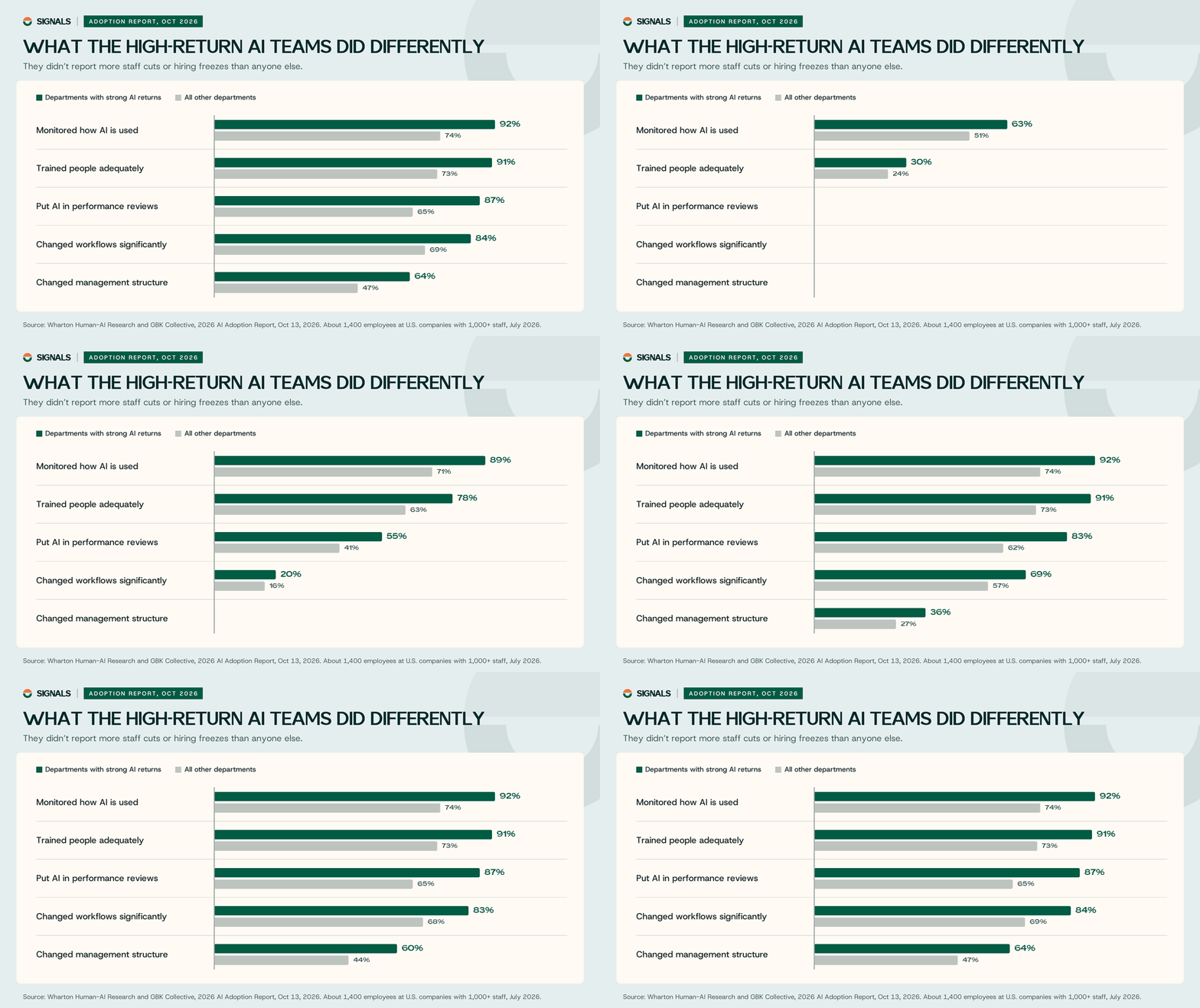
This same study found that departments judging AI by growth were nearly three times as likely to report strongly positive returns as the ones judging it on efficiency alone (35% versus 13%). Most organizations today still measure AI in hours saved, or believe this is the true, KPI-needed stat, which makes sense because it’s easier to compartmentalize, but the teams seeing real returns are measuring what those hours turned into rather than saved.
McKinsey study Cody posted, and he’s right, EVERYONE should read it, is pointing in the same direction. In AI is changing work. Now it has to change the organization (published on October 5), The authors argue that work should be organized around outcomes instead of departments, and they call the result an “orchestration chart”:
who owns the result
which people
which AI agents contribute
where human judgment has to sit
A week later, in this AI operating system, McKinsey asked CEOs whether a manager could coach 20 to 40 people instead of today’s 10 to 12 if AI took over more of the info gathering and status reporting. McKinsey poses that as a question from its client work, and it isn’t truly a measured result but it does tell you where the manager’s job is heading, which is toward less relaying of information and a LOT more coaching and judgment. (middle managers can take a breath of relief but also, don’t let this become the therapy chair either.)
Yet with all of this, most organizations haven’t started the process.
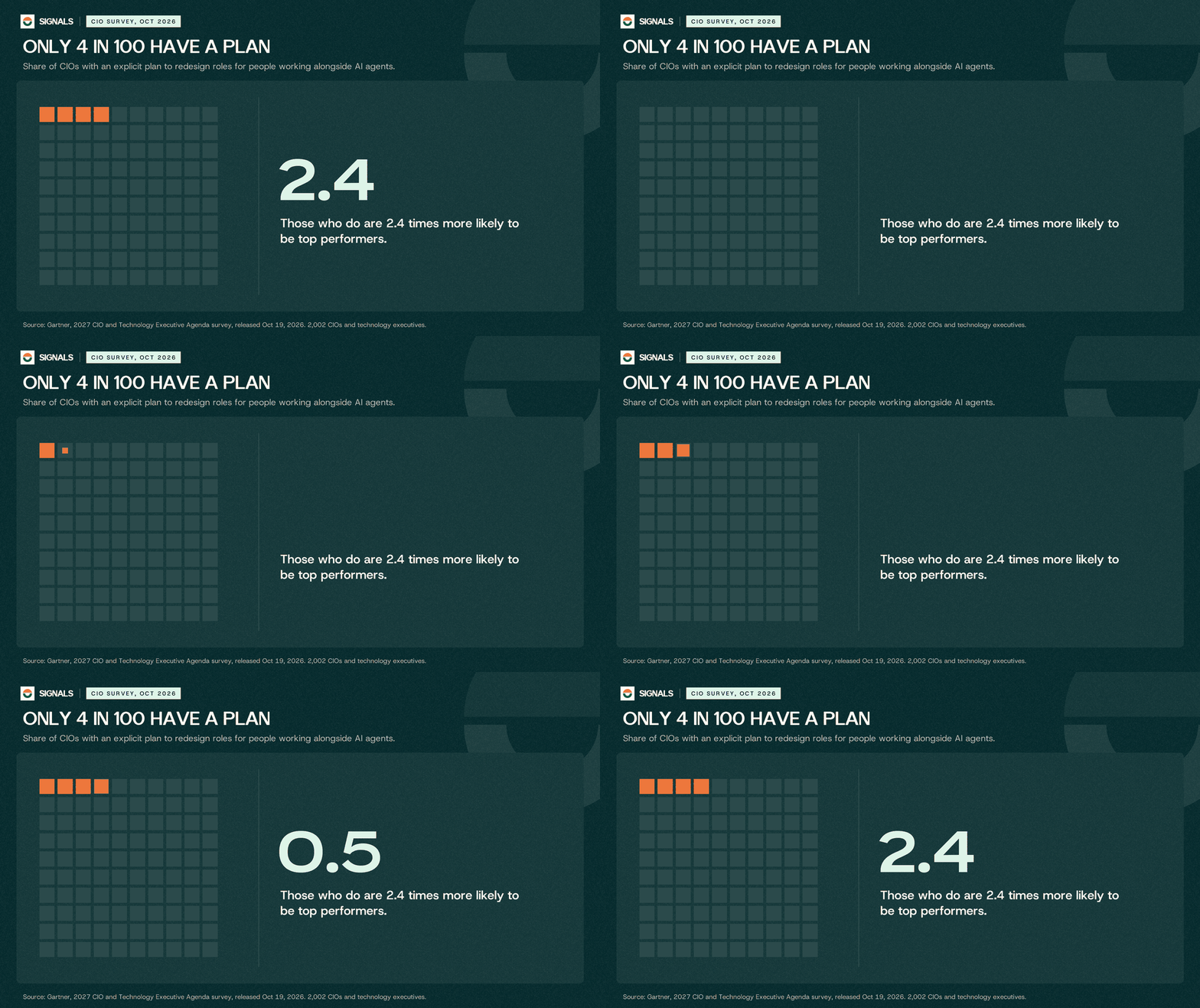
Gartner’s CIO survey released also last week on Oct 19, found that only a teeny 4% of CIOs have an explicit plan to redesign roles for people working alongside AI agents, and the ones who do are 2.4X more likely to be the top performers in their organization. 4% is roughly the share of your board members who read the whole packet before the meeting.
A day later, Gartner’s CEO survey had 63% of CEOs naming a redesign of how the organization runs as a top move for getting returns from AI by 2027. So the leaders know where the value is, and we don’t really have a plan yet, as an industry or as individual organizations. We need to get our life together here.
What yesterday’s Claude announcement means for your team, or really all the announcements on personal agents.
If you read the October 8 issue, you met dots and Muse, the first wave of agents for normies.
Aka no need to geek out in Claude code, terminals, VS code like us AI dorks do. Just yesterday Anthropic previewed the next one which I am personally so excited for, Claude Duet, and this one is pointed squarely at daily work. It’s built for professionals and small business owners, and in Anthropic’s description it sends you a morning brief, flags what needs your attention, drafts replies for your review, follows up on the threads, and takes on the big jobs like a research briefing, a deck or a dashboard.
It runs on its own cloud computer, so it keeps working after you close the app, which is either the most helpful thing that’s ever happened to a four-person marketing team or the opening scene of Terminator 2. It’s a research preview for now, rolling out by waitlist to U.S. Pro and Max subscribers (ugh), and it’s designed to ask before it sends a message, makes a payment, signs anything or deletes anything. Or if you are a psychopath, you can override this.
Just think about what that looks like inside a DMO.
Your partner manager starts the day with every partner email that needs an answer already sorted and a first reply drafted. Your sales director’s lead follow-ups to the planners who went quiet are written before the coffee is. Your CEO gets the board packet pulled together from five different reports overnight. The person still makes every call and sends every message, and what changes is the hour or two (or week) of sorting and chasing that comes before the real work.
This is also where the org chart conversation gets very real, because tools like this land on individuals first, long before they reach a department plan. If leadership doesn’t set expectations, you’ll end up with one person running half their job through an agent without telling anyone and three other people afraid to admit they’ve never opened one, and neither of those is a culture anybody chose on purpose. (Sorry in advance for calling out the ones automating everything already….)
So what does this look like at a 17-person DMO?
Most of this research was done inside big companies, and I don’t want to stretch it onto us. The last time Destinations International published the number, the median destination organization had 17 full-time staff and plenty of DMOs run so much smaller than that.
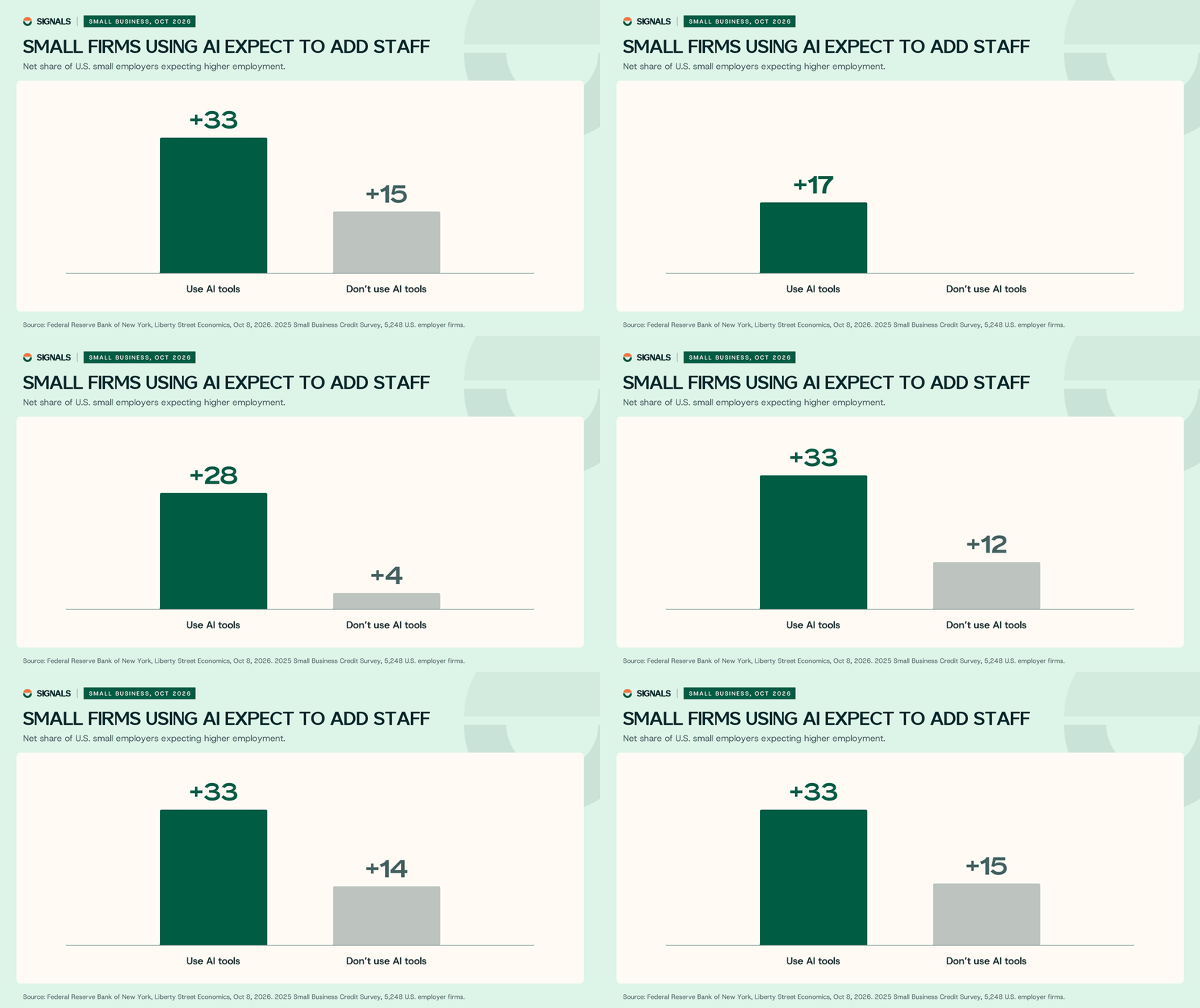
The good news is that the small-employer data points the right way. The New York Fed looked at more than 5,000 U.S. small employer firms and found that the ones using AI were more likely to expect to ADD (yes, add) staff, a net +33 versus +15 for firms that don’t use it. The analysis published October 8 and the survey itself ran in late 2025, but it’s the closest thing we have to a DMO-sized answer, and it points toward growth.
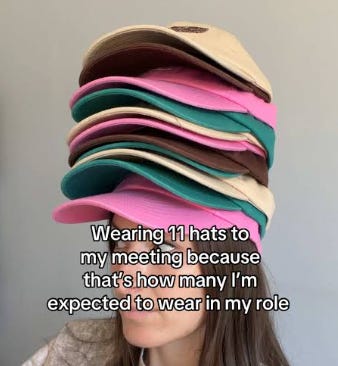
McKinsey Global Institute’s October 15 chart frames the change as something that happens inside the job: more than 70% of U.S. workers may need to reinvent how they work, and about a quarter could see more than 30% of their time shifted to different tasks. Gartner adds the piece that fits a small DMO best, which is that as AI takes on more specialized tasks, organizations will need fewer distinct role types, with each role covering more ground. If you run a 12-person team, you already live that way, because your digital manager is also your web producer, your social lead and the person who fixes the printer.
It’s rare for a DMO to have a dedicated AI role on staff. I went looking this year and couldn’t find a U.S. city or county DMO that had announced one, and that’s okay, because I don’t think that’s the route for most of us anyway. The 2027 version of a small DMO adds AI into the roles you already have:
Someone owns the content and the data underneath it. Listings, events, hours, partner details. If it’s wrong, every AI assistant repeats the mistake, and so does your visitor center.
Someone leads the AI work around an outcome, like the partner newsletter or the RFP pipeline. McKinsey describes this as a senior individual contributor who leads AI agents toward a result. In DMO terms, that’s your sharpest coordinator getting real ownership of something.
Your managers coach more and report less. The weekly status meeting shrinks, and the one-on-ones get longer.
Your relationship people get more time in the field. Partner managers, sales and sports teams, community relations. That’s the work AI can’t do, and it’s where those freed up hours should go first.
The example I love is with Visit Mesa, which last fall had every role set at least one AI objective in its performance plan. They didn’t add any new boxes to the chart. They changed the expectation inside every box that was already there.
Your team is very likely walking on eggshells
Before any of this turns into a plan, it’s worth being honest about how it feels on the other side of the CEO’s door.
Across our industry, I’m hearing the same thing from middle managers and staff. People are really nervous around AI, and in a lot of offices, it has turned into this quiet, “vibe feels off” resentment.
They’ve read the same layoff headlines you have. Challenger, Gray and Christmas counts AI as the top cited reason for announced U.S. job cuts in 2026, about 21% of the year’s total. Your designers, writers, and any staff with creative roles are watching work that used to take a week get done in an afternoon, and they’re wondering what that means for them. Anyone who lived through 2008 or 2020 in this industry knows how quickly “finding efficiencies” turns into a reorg memo, so the nervousness isn’t irrational at all.
The data backs up what they’re feeling.
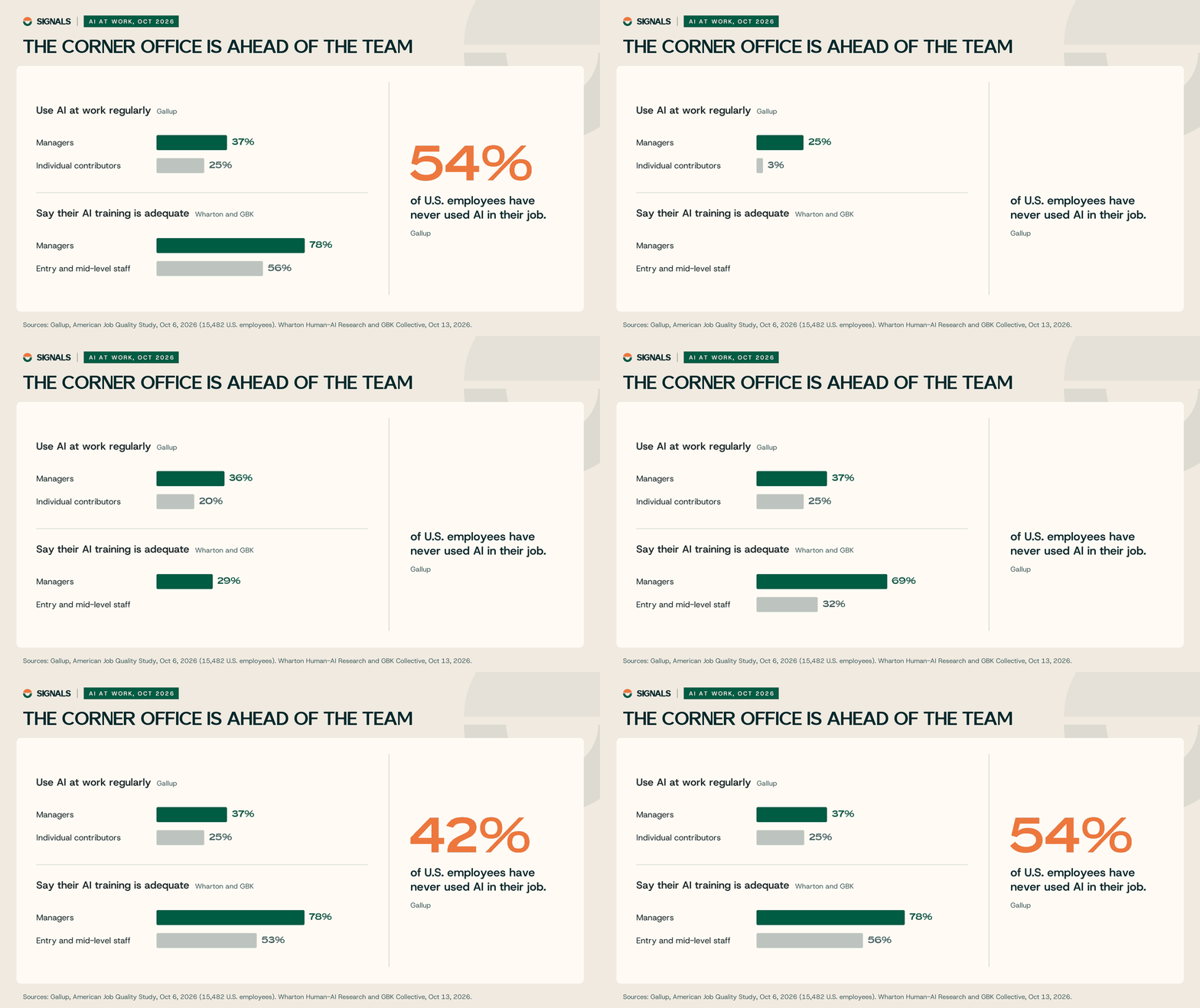
Gallup’s American Job Quality Study, out October 6, found that 54% of U.S. employees have never used AI in their job, and that managers are more regular users than the people they manage (37% versus 25%). Wharton found the same split from another angle: 78% of managers say employees get adequate AI training, but only 56% of entry and mid-level employees agree. Wharton also found that enthusiasm is cooling as use goes up, with the share of people who feel excited about AI down 8 points to 51% and the share who feel cautious up 7 points to 44%. And in the departments that did cut staff because of AI, 61% of managers now worry about their own role, compared with 18% where no cuts were made, which tells you the fear doesn’t stay in one row of the org chart.
So, real talk to CEOs:
The first step is never cutting your staff. Cutting first gets you fewer people running the same broken workflows, a team that resents the tools, and a savings line you’ll spend 2028 explaining. The first step is looking at how AI fits across your whole team, role by role, and before you roll anything out, getting a real read on how your people feel about it. An anonymous pulse survey takes a week and costs nothing (I’ve provided a prompt below to build one for you). A CEO who uses ChatGPT every morning tends to assume the team is in the same place, and the team is usually worried about what the CEO is planning. That gap is where 2027 planning goes sideways, and it’s also the easiest one to close if you ask before you announce.
Meanwhile, the work itself shifted
All of this would be a nice management conversation if the market were holding still…
but, of course, (naturally) it isn’t.
Skift Research tested ChatGPT, Gemini and Claude with different traveler profiles and found that the assistants change how they describe a destination for each person, but rarely change which destinations they recommend. The top 10 destinations took 48% of the recommendations, and in 29% of the cases where the assistant itself rated a destination a strong fit, it still never recommended it. Skift’s advice to destination marketers was to treat showing up in those answers as a distribution problem.
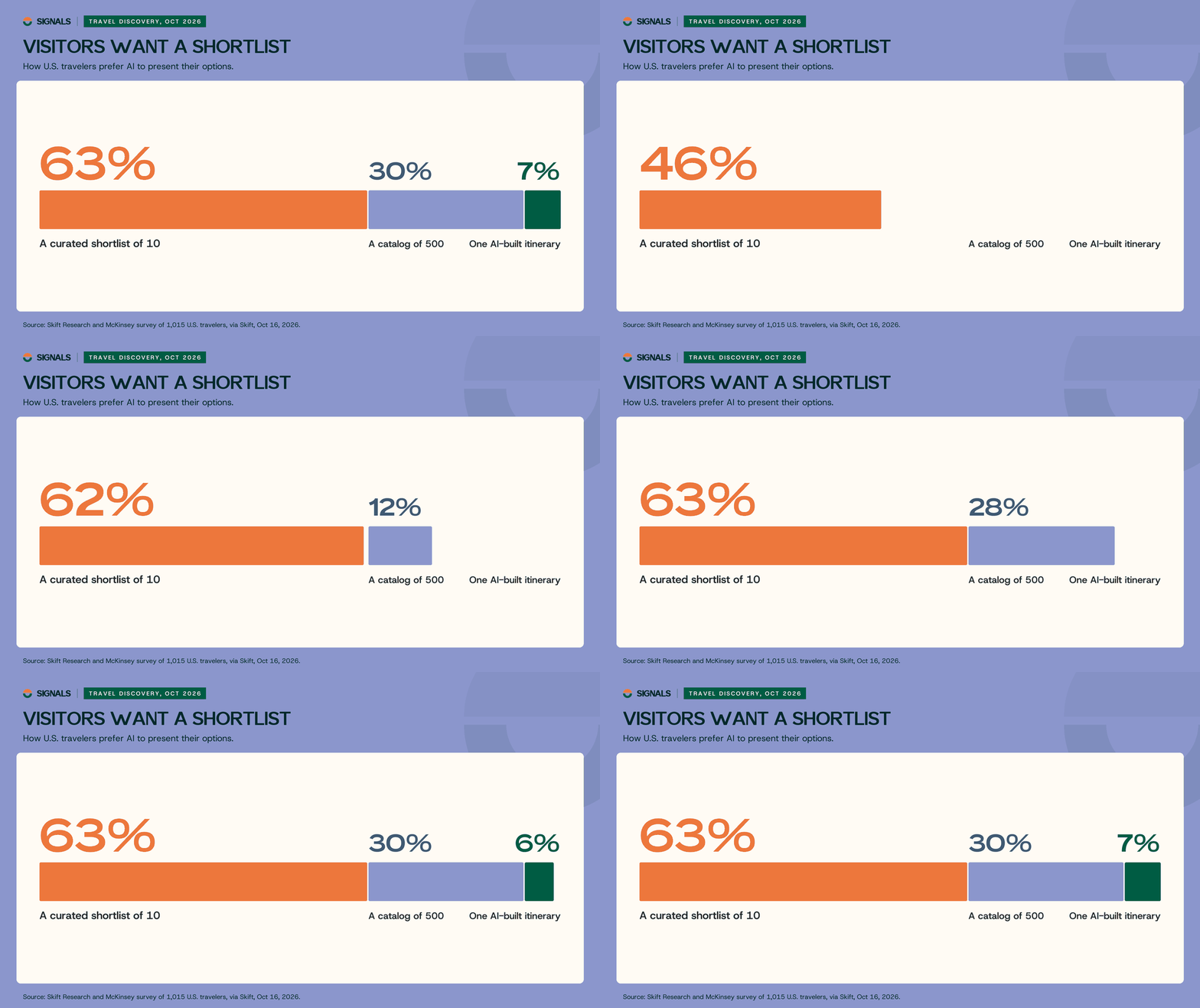
The same research shows a survey of 1,015 U.S. travelers by Skift Research and McKinsey, saying 63% want AI to give them a curated shortlist of about 10 options, and only 7% want a single AI-built itinerary.
Friends, the curated shortlist is the job we’ve been doing since the first visitor guide went to print.
The other theme here is the pretty well-known one that discovery moved and booking didn’t. AI shows up in 21% of trip touchpoints during inspiration and only 6% at booking, and Booking Holdings told investors this summer that AI drives well under 1% of its room nights. The assistants are shaping the shortlist, which is the part of the trip we’ve always owned.
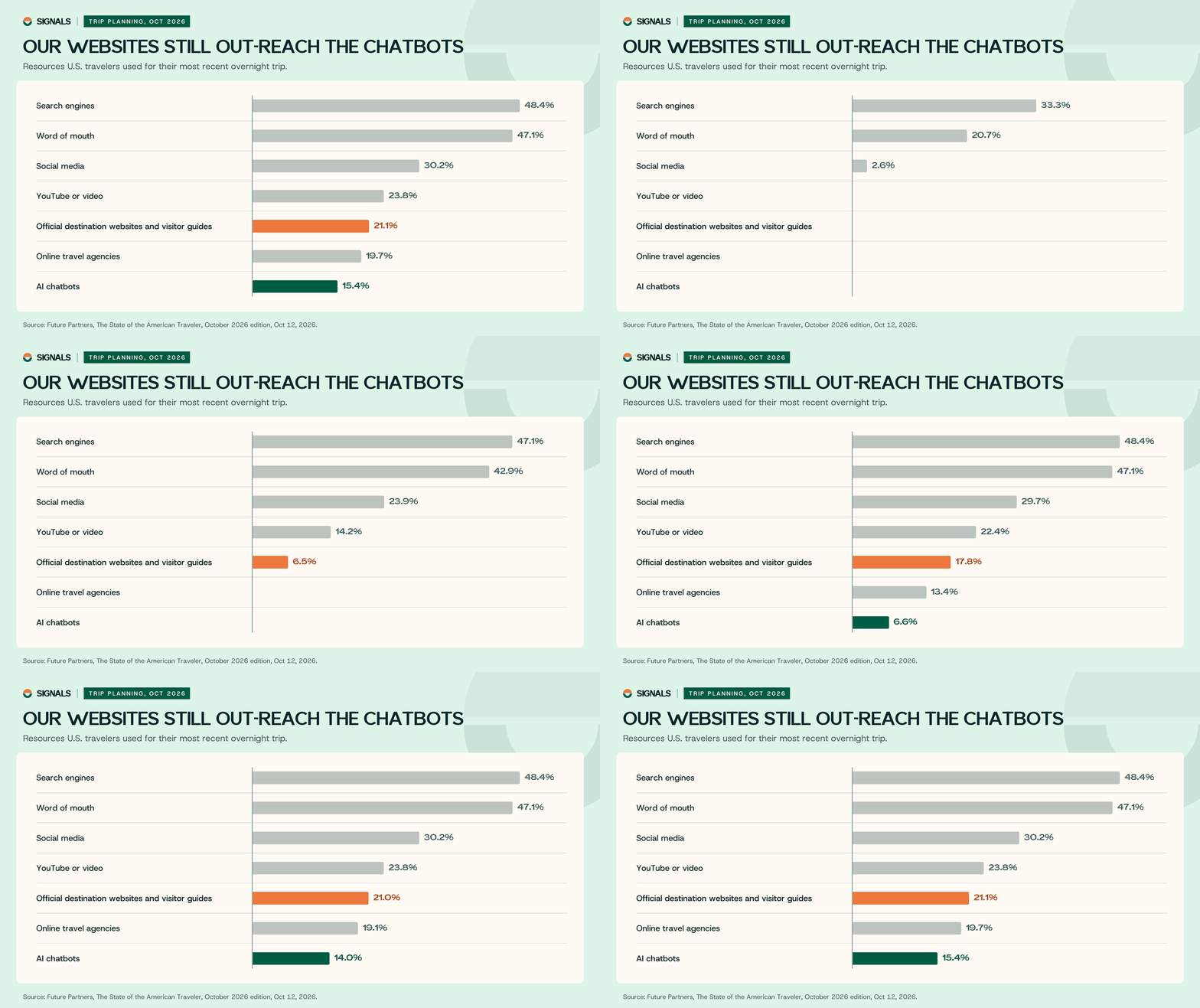
Our own visitor data says the same thing. Future Partners October edition found that 32.2% of U.S. travelers used AI to plan a trip in the past year, but only 15.4% used an AI chatbot on their most recent trip, and official destination websites and visitor guides still reached more of them, at 21.1%. MMGY’s fall POAT found only 4% put AI among their first three planning steps. AI comes in once visitors are narrowing down, after the dreaming has started somewhere else, and that’s the window open.
And yeah, it won’t stay open forever.
In the last 3 weeks alone, ChatGPT ads expanded to 89 countries, Google started testing ads inside AI Mode, Meta and Sierra announced an open standard for how personal AI agents work with businesses, and Booking Holdings put its new assistant, Vayo, into private beta with up to $100 million behind it. Rafat Ali admitted on October 15 that he can’t keep up with the launches either: “Every new travel assistant wants to simplify my life, starting with another introduction.” Same, Rafat, and that was before Duet showed up.
Every one of those changes impacts your staff. Somebody has to track it and decide what changes on the site, in the partner program, in the media plan, and right now at most of our organizations that somebody is “whoever has extra time,” which is exactly the problem the orchestration chart is supposed to solve.
The Fall Numbers
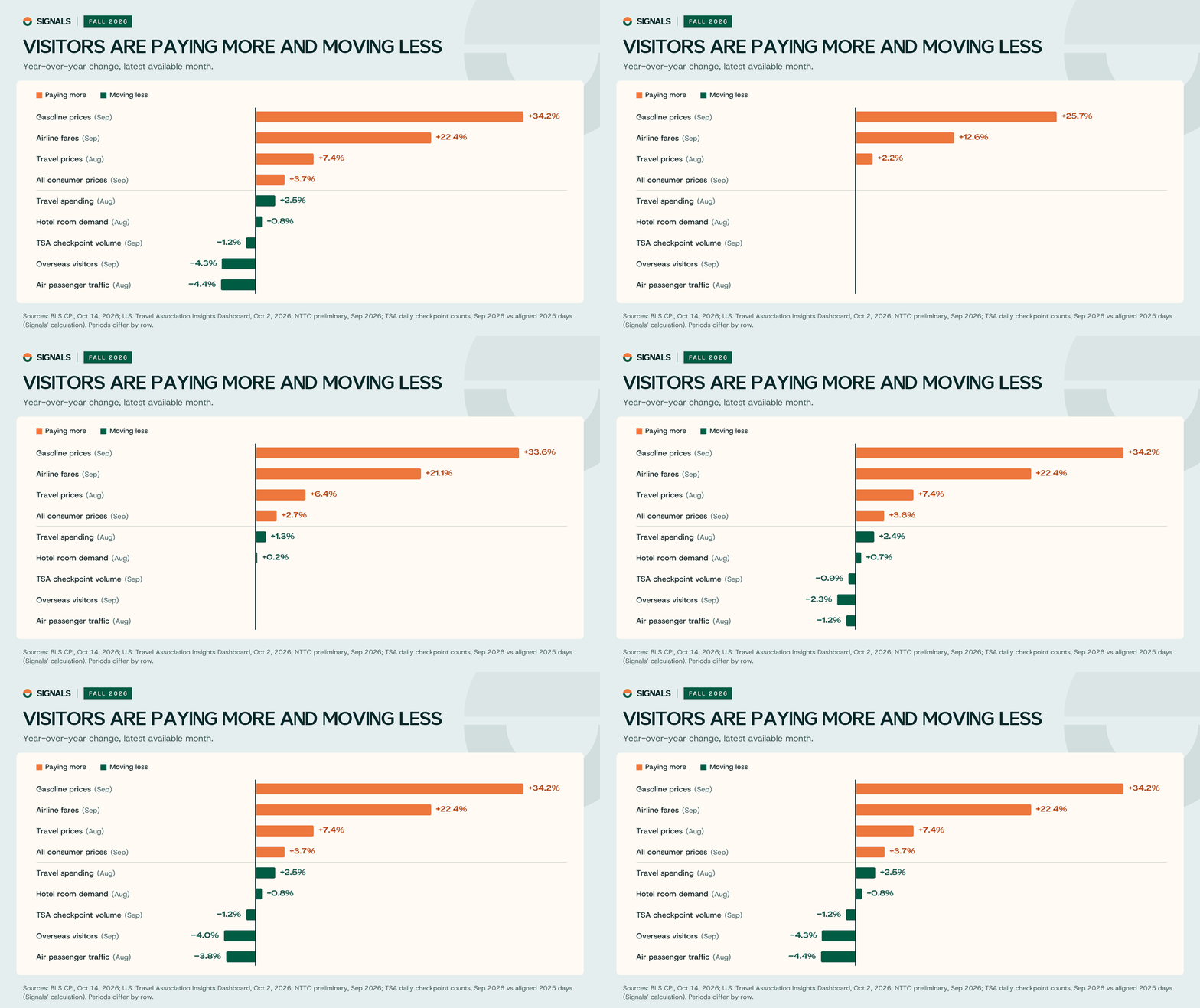
One more reason 2027 planning feels tight is that visitors are paying more and moving less.
Airline fares are up 22.4% over the past year and gasoline is up 34.2%, against 3.7% for all consumer prices (BLS, September CPI, released October 14). That’s great news if you’re a fly market, and United’s third-quarter revenue rose 17.4%, but TSA’s daily checkpoint counts ran about 1.2% below the same days last year in September and about 2% below in the first 20 days of October, and U.S. Travel’s dashboard has August air passenger traffic down 4.4%. Price is carrying the industry right now, and volume just isn’t keeping up.
Gas prices have become a real mess too. Future Partners found that 32.7% of U.S. travelers say high gas prices kept them from traveling more in the past 6 months, up way too much from 15.3% a year ago, and it’s closer to half for travelers earning under $49,000 and for rural travelers. If you’re a drive market, that’s the number to bring to the board.
International visitation is also…still sliding.
NTTO’s preliminary count has September down 4.3% and the year down 5.7%, and the World Cup months didn’t reverse it either, wonder why… (June was down 1.8% and July down 7.0%).
The loss is in leisure visitors. Western European tourism-visa arrivals fell 11.6% in September, while business-visa arrivals rose 5.4%. Canada turned positive from May through July, though off a 2025 base that had collapsed, so “recovering” is the right word and “recovered” isn’t yet.
There is some good news. Columbus Day weekend set the highest weekend hotel rate on record, $198.68, with CoStar’s caution that last October’s shutdown makes this October’s comparisons look better than they are. And 48.4% of U.S. travelers plan a holiday trip, with almost a third of the ones who aren’t visiting family still undecided on where to go, and those are the visitors we can still win this year.
4 Things your team can run this week
These prompts below are built for a small DMO team.
Paste these house rules into the top of a shared prompt doc first, then run any of the four in ChatGPT, Claude, Copilot or Gemini, whichever account your organization has approved.
Start with the first one here ⬇️
HOUSE RULES FOR EVERY PROMPT WE RUN
1. Use only the AI assistant account our organization approved, with model training on our conversations turned off.
2. Never paste passwords, partner or visitor personal information, hotel rate grids, contract terms, unreleased budgets, or anything about an individual employee.
3. Replace names with roles before pasting ("Hotel A," "Planner 2").
4. Every output is a first draft. A named person on our team checks facts, numbers and tone before anything leaves the building.
5. The assistant must say when it's unsure and must never invent a number, quote, source or policy.
1. Take the temperature first (the team pulse)
Before you change a single workflow, find out how your people feel about AI, and do it anonymously. On a team of 15, anonymity is fragile, so the prompt is built to protect it. The CEO or HR lead runs this, shares the summary with the whole team, and says what leadership heard.
You're an organizational development advisor to a destination marketing organization with [number] staff. Before we roll out any AI tools or change any roles, we want an honest read on how our team feels.

1. Write an anonymous pulse survey of 10 questions or fewer that takes under five minutes. Cover: how often people use AI assistants today, how confident they feel, what worries them (job security, the quality of creative work, workload, being judged for using AI or for not using it), what they'd most like help with, and one open question: "What should leadership know before we change anything?"
2. Use warm, everyday wording a nervous colleague would trust. No leading questions, and nothing that could identify a person on a small team (no department plus tenure combinations).
3. When I paste the results back, summarize the themes with counts, separate worries from wishes, quote nothing that could identify anyone, and draft three things leadership should say out loud before any rollout.

If fewer than five people answered a question, say the result is too small to read.
2. A week in the life.
Before anyone redraws the org chart, every staff member logs a normal week: task, minutes, who it serves, and one “wish I had time for” note. The CEO says to the team that this is about freeing time, never about cutting roles. Then the leadership person tasked runs this:
You're an operations advisor to a destination marketing organization with [number] staff in [departments]. We're planning 2027. This exercise will never be used to reduce anyone's role or evaluate performance.

Below is a one-week task log from our whole team, names removed (role, task, minutes, frequency, who it serves, "wish I had time for").

1. Group similar tasks across roles and total the minutes, using only the log.
2. Sort each group into four lanes: Human-led (relationships, judgment, presence), AI-assisted draft (a person finishes it), Template or automate (same every time), and Reconsider (low value to visitors, partners or the board).
3. For the AI-assisted and automate lanes, note what goes wrong if the assistant makes a mistake, and whether it could reach a visitor, partner or board member.
4. Group the "wish I had time for" notes by theme. That's where freed time should go.
5. Write five questions for our team workshop.

Don't estimate time savings. Don't recommend changing anyone's role, title or headcount. If a task is unclear, list it under "Needs clarification."
3. The 2027 role charter.
Each person, not their manager, drafts a one-page charter for their own role, then brings it to a 1v1. It gives your team authorship over how their work changes, which is the best antidote I know to the corner-office gap.
You're a career coach who knows destination marketing organizations. Help me write a one-page charter for my own role in 2027, for a growth conversation with my manager.

Below are my job description and my rows from our team task log (names removed).

1. Name the three to five parts of my job that depend most on people: relationships, judgment, presence, local knowledge.
2. Name the tasks where an AI assistant could give me a first draft, and the check I'd still do.
3. Suggest one skill to build in 2027 that makes my human work stronger, with three first steps.
4. Help me finish this sentence three ways: "If I had four more hours a week, I would spend them on..."
5. Write three questions to bring to my manager.

Write in my voice, first person. Never suggest any part of my role be eliminated. If my job description and my task log disagree, point it out and ask me.
4. The visitor center question log.
Your visitor center staff hear the questions every website and assistant should answer. Once a month, paste the de-identified log and inquiry emails and turn them into team knowledge. It also gives your frontline people a visible, strategic role, which they’ve earned.
You're a visitor experience analyst for a destination marketing organization. Below is one month of visitor center questions and inquiry emails for [destination], with names, emails and phone numbers removed.

1. Group the questions into themes and count each, using only the log.
2. List the 15 most frequent questions in the visitors' own words.
3. Flag questions that suggest a need we may not be meeting (accessibility, language, transportation, pets, budget, families, late-night options).
4. Note anything seasonal or tied to an event.
5. List questions a partner business could answer better than we can, and which type of partner.

Give me a one-page front desk brief, a list of questions we can't answer from what I pasted, and a half-page memo for partners. Don't answer visitor questions unless the answer is in what I pasted; write "needs a verified answer" instead. If the log is too small to show a pattern, say so.
Five Plays to Take Back to Your Team
1. Make the first move a conversation.
The first step is never cutting staff. Run the pulse survey, share what you heard, and tell your team clearly what AI is for at your organization (more time for partners, visitors and creative work) before you ask anyone to change how they work. Our industry runs on relationships that take years to build, and the people who know which hotel GM picks up on a Sunday and which planner hates a buffet are the people you’re building 2027 around.
2. Map the work before you redraw the org chart.
Run the task inventory next. McKinsey’s orchestration chart starts with outcomes and handoffs instead of titles, and a week of your own team’s data will tell you more than any consultant’s benchmark (mine included).
3. Put the training money where the gap is.
The high-return departments in Wharton’s study trained their people, and the people below the manager line are the ones who don’t feel taught. Make training a real line item in 2027, keep it hands-on with your team’s own work, and give everyone time to try tools like Duet, dots and Muse on their actual jobs.
4. Write AI into the roles you already have.
You don’t need an AI director, and almost no DMO has one. Name the person who owns content and data quality and the person (any level, and rotating is fine) who owns how the team uses AI, then put at least one AI objective in every performance plan, the way Visit Mesa did.
5. Measure what the freed time turns into.
Hours saved is the weakest story you can tell a board. Track the time AI frees up and, in the same column, where that time went: partner visits, sales calls, community work. Label it self-reported, and remember that in Wharton’s data the growth-minded teams are the ones seeing returns.
Draw the 2027 org chart in a handwritten note, then spend the ink on your people.
What’s the one task you’d hand off tomorrow if you could?
Stay sharp,
-Emily
This ran first on Signals
Emily writes weekly on AI, discovery, and what it does to destination marketing. Subscribe and it lands in your inbox before it lands here.